

Tuesday's SCOTUS Hearing Augurs Good News for Biological Female Athletes
Justices’ questions suggest a majority is skeptical of forcing women’s sports to ignore biology.

⏱️ 6.5-minute read
Most of our afternoon content is for paid subscribers. Think of it like an iceberg: only a small part is visible to everyone, while the rest is reserved for subscribers. To access the full post, you’ll need a paid subscription.
Signals from the Supreme Court Bench
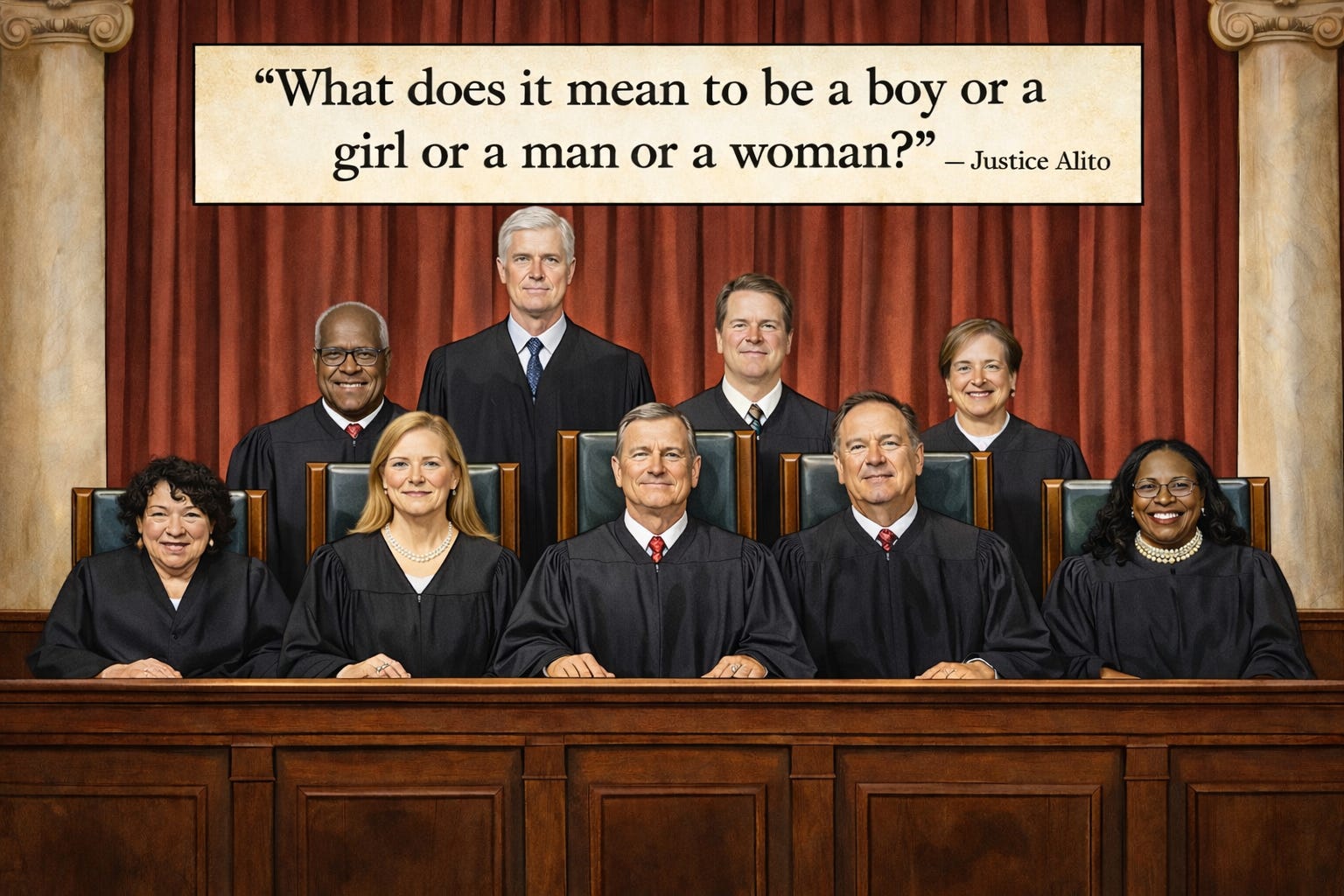
On Tuesday, the United States Supreme Court heard arguments in two cases that could decide if women’s sports remain protected by law. Supporters of fairness noticed the justices’ line of questioning. In Little v. Hecox and West Virginia v. B.P.J., the Court is considering whether states can prevent biological males from joining girls’ and women’s teams. While a decision is still months away, the justices’ questions suggest most are not ready to ignore biological differences.
If the justices hold this view, women’s sports may be protected from policies that make sex-based categories optional. This is not just a theoretical issue. The Court is deciding whether women’s athletics still have a solid legal basis as a separate and protected category.
The cases focus on laws in Idaho and West Virginia that only allow biological females to join female sports teams. Idaho’s law covers public schools and colleges, while West Virginia’s law applies to K–12 sports. Attorneys for biological male athletes who want to participate in girls’ and women’s sports argue these laws violate the Equal Protection Clause and Title IX. The states say that separating sports by sex is not discrimination, but a way to make sure girls and women have real chances to compete.
The Justices Focus on Reality, Not Rhetoric
During the arguments, several justices kept raising the same point: if biological sex is no longer the basis for women’s sports, there is no clear rule left. Chief Justice John Roberts asked whether the lawyers truly supported sex-based differences in sports, or if they wanted an exception that would eventually remove the category.
Justice Brett Kavanaugh emphasized a point that athletes know well. In competitive sports, there are only so many spots on a team. Scholarships are limited. Not everyone gets the same playing time, medals, or titles. When one athlete gets an advantage, someone else misses out. He asks what should be said to the many girls and women who object to competing against biological males. His questions reflected a reality often overlooked in public debate: female athletes have legitimate interests of their own.
Why Title IX Suddenly Matters Again
Justice Neil Gorsuch, who wrote the 2020 Bostock v. Clayton County opinion expanding sex protections in employment, seemed doubtful that Title IX should erase sex-based differences in sports. When Congress passed Title IX in 1972, “sex” was generally understood to mean biological sex, and schools organized sports accordingly. I mean, when you think about it, in what world would one think that someone’s sex would be considered subjective?
The three liberal justices on the Court challenged whether states had sufficient justification for these broad exclusions and suggested more case-by-case solutions. However, these ideas complicate enforcement and could weaken women’s sports. If eligibility is based on personal identity or on changes in medical treatment, the women’s category could lose its stability.
California Is Potentially On A Collision Course
These legal questions are especially important in California, where state leaders have taken a different approach. Governor Gavin Newsom and the California Interscholastic Federation have enacted policies that put gender identity above biological sex, and they have not supported efforts to keep women’s sports as a protected category. Right now, CIF rules allow biological males to compete in girls’ events.
Depending on the Supreme Court’s decision and its breadth, the outcome could change the legal landscape for states like California. It would not immediately overturn California’s current policies, but it could significantly advantage current litigation filed by the U.S. Department of Justice accusing the State Department of Education and CIF of Title IX violations.
California has already experienced the effects of these policies. In high school track and field, A.B. Hernandez, a biological male “identifying” as a female, competed in the girls’ division under CIF rules and won state titles in the triple jump and high jump. Hernandez was also the cause a rival high school forfeiting a volleyball game against his school, as they protested the unfairness of playing against a team with biological man on it. This caused controversy across the state, as it should. Female athletes and their families raised concerns about fairness and lost opportunities, but officials mostly dismissed their objections.
So, Does It Matter?
No matter how the Court writes its opinion, whether it is narrow or broad, the effects will reach beyond Idaho and West Virginia. If the Court says states can keep sex-based rules in sports, it would reinforce a basic idea: women’s sports exist because women and men are biologically different.
For states like California, such a ruling could prompt a necessary review of policies that have prioritized ideology over fairness. For female athletes across the country, it would make clear that biological reality is still important and that women’s sports exist to protect those differences.
This issue also puts Governor Gavin Newsom in a difficult spot as he runs for president. In California, his administration supports letting biological males compete in girls’ sports. But in a public interview, Newsom called these policies “deeply unfair.” That contradiction might be manageable in California, where Newsom was never really held to account, but it will be harder to explain nationally, especially if the Supreme Court upholds sex-based protections in sports.
Jon
His name is not "AB" it's Abraham .