

*Breaking* New Berkeley IGS Statewide Survey Reveals A Wide-Open California Governor’s Race Defined By Fragmentation, Not Momentum
Republicans Benefit From A Unified Base While Democrats Split Their Vote And Undecided Voters Wait For A Reason To Engage

⏱️ 5 min read - You can also listen to this on the “So, Does It Matter? Spoken” podcast on your favorite podcasting app, or go here. For paid subscribers, I have video analysis under the paywall.
A Race Defined By Fragmentation, Not Leadership
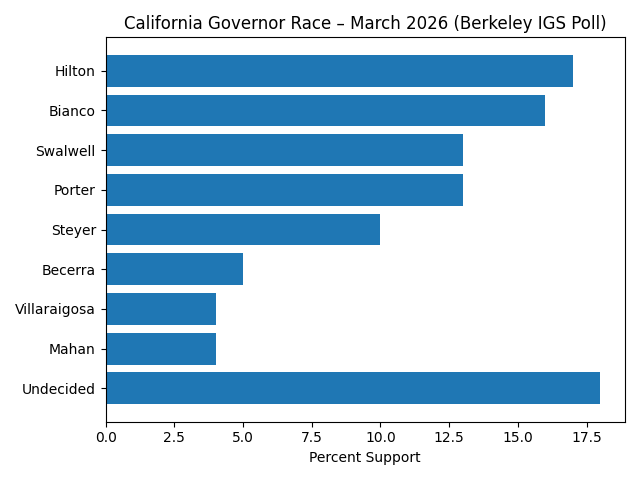
The latest UC Berkeley IGS Poll offers a revealing snapshot of California’s gubernatorial race — and it is one that is easy to misinterpret at first glance. On the surface, Republicans appear to be gaining ground, with Steve Hilton at 17% and Chad Bianco at 16%, placing them at the top of the field.
But that is not the real story.
The more important fact is that no candidate — not one — has reached even 20% support. In a race of this size and at this stage, that is not a sign of strength. It is a sign of a field that has not yet taken shape.
Democrats, despite their significant registration advantage, remain divided across multiple candidates. Eric Swalwell and Katie Porter are both stuck in the low teens, with Tom Steyer trailing behind them and the rest of the field barely registering. No Democrat has emerged as the clear choice of their party, and in fact, none is receiving more than about a quarter of Democratic voter support.
This is not a race with momentum. It is a race still searching for direction.
Why Republicans Are Leading Without Expanding
The explanation for why two Republicans are leading in a heavily Democratic state lies not in a shift in voter ideology, but in the structure of the race itself.
Republican voters are overwhelmingly consolidated, with roughly nine in ten backing either Hilton or Bianco. Democratic voters, by contrast, are fragmented among several candidates competing in the same ideological lane and offering largely similar messages.
In California’s top-two primary system, this distinction is critical. Victory does not require a majority; it requires finishing in the top two. A unified minority can outperform a divided majority, and that is precisely what this poll reflects.
Republicans are not necessarily expanding their coalition. They are benefiting from discipline and clarity. Democrats, meanwhile, are diluting their own support, preventing any single candidate from breaking through.
Until that dynamic changes, the current standings are likely to persist.
What The Issue Breakdown Reveals About Each Coalition
The most instructive part of the poll is not simply who voters support, but what is driving their decisions.
Among supporters of Hilton and Bianco, priorities are consistent and clearly defined. About half say it is important that a candidate is conservative, and roughly four in ten prioritize support for Trump administration policies. This is a cohesive bloc grounded in shared beliefs and a well-defined political identity.
Democratic voters present a different picture. Their primary motivation is selecting a candidate who will aggressively oppose the Trump administration, with a secondary emphasis on progressive ideology. However, this creates a structural problem: multiple candidates are offering the same rationale for support, leaving voters with little basis for choosing one over another.
The result is predictable fragmentation.
Undecided voters add another layer of complexity. While they lean toward Democratic issue priorities, they place greater emphasis on competence, effectiveness, and independence from special interests. This suggests a group that is less ideologically rigid and more focused on performance and credibility.
That makes them the most fluid and potentially decisive bloc in the race.
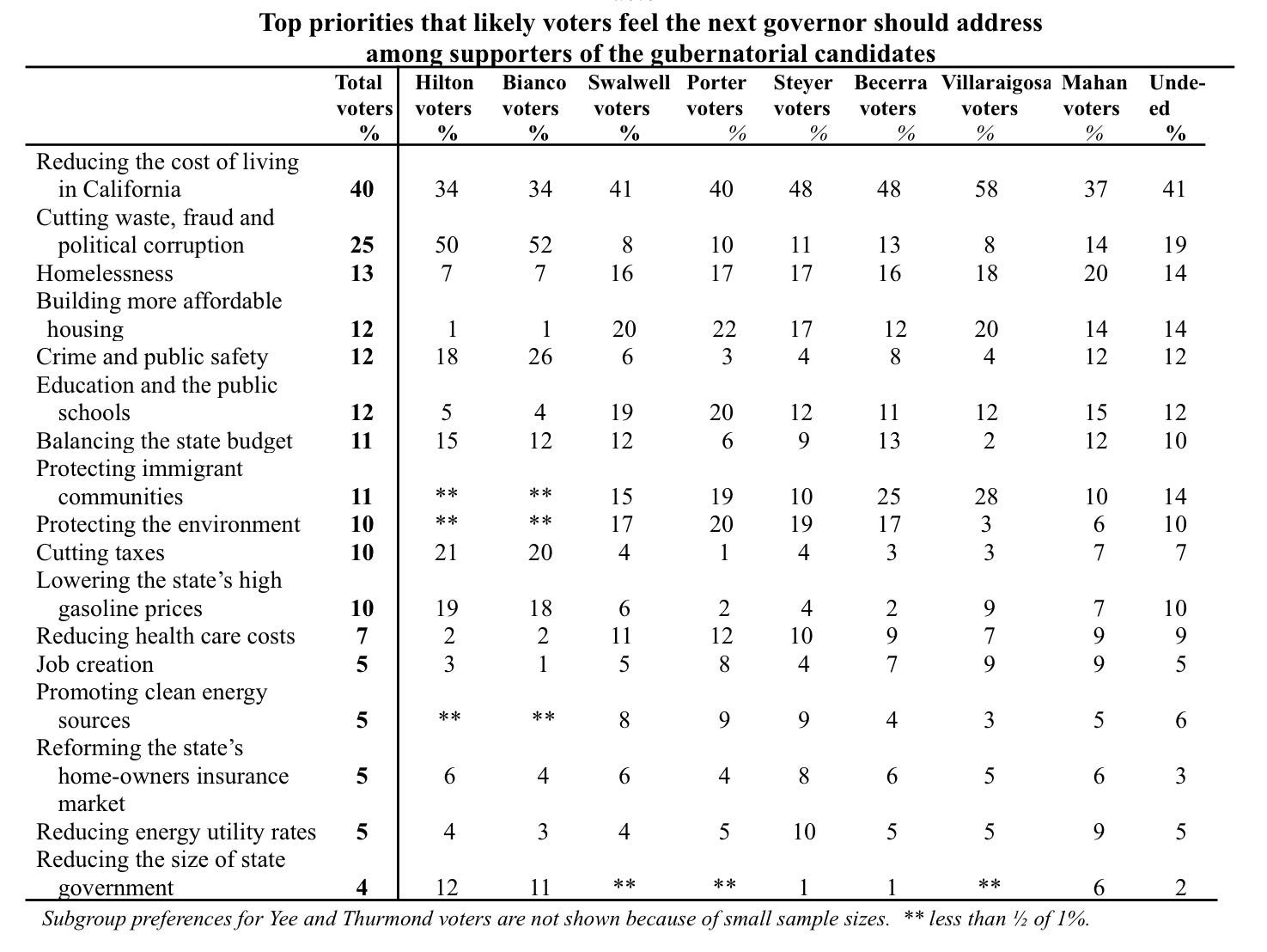
It is worth digging into this chart yourself. Here you can see the issues that matter to supporters of Republican and Democratic candidates. And of course, with the eye on the prize, what matters to undecided voters…
So, Does It Matter?
Of course, this matters because the poll tells us this is still not a settled contest, but a race defined by instability.
The current standings are not the result of one side persuading voters more effectively than the other. They are the result of one side remaining unified while the other remains divided. That distinction is driving the outcome more than any single candidate’s message or performance.
Equally important, the electorate itself remains disengaged. Large portions of voters still report having no opinion of the candidates, and not a single major candidate is viewed more positively than negatively statewide.
That is highly unusual at this stage of a statewide campaign and suggests that voter preferences are still malleable.
This creates a volatile environment. If Democratic voters eventually consolidate around a single candidate, or if one campaign manages to break through with a compelling message, the dynamics of the race could shift quickly. If not, the current structure will continue to dictate the outcome.
And in a system like California’s, that structure alone could produce an outcome that reflects not a change in voter ideology, but a failure of political organization.
