

*Breaking* Iran's Supreme Leader, The Murderous Ayatollah Khamenei Killed as the U.S. And Israel Conduct Military Operations All Over Iran
We're a website focused on California Politics, but I have thoughts here...

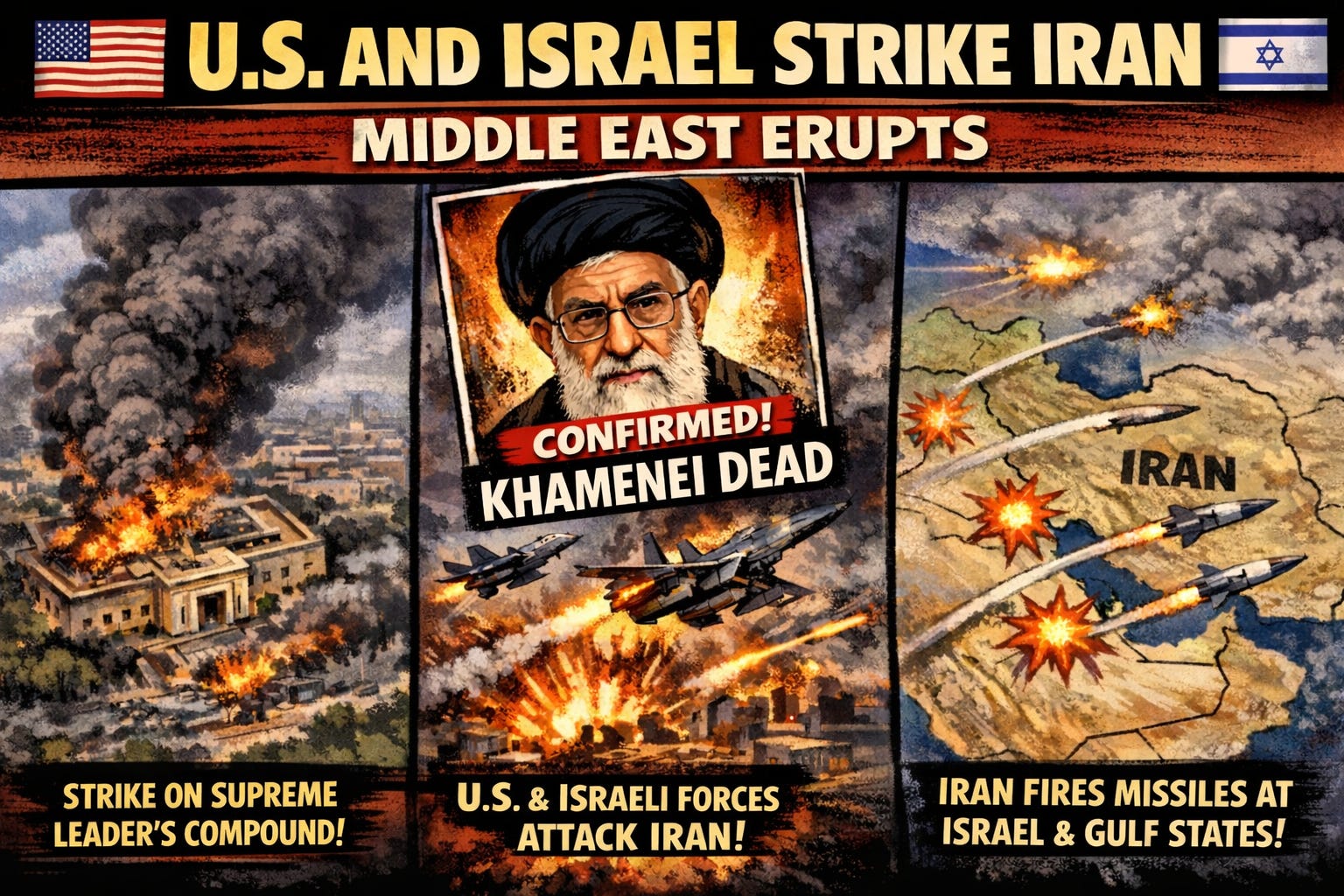
This Substack is primarily devoted to California politics. That is where I spend most of my time and where I believe I can add the most value. But from time to time, events occur that demand comment beyond our state’s borders. This morning’s military action against Iran by Israel and the United States is one of those moments.
As I write this, President Trump has announced that the initial strike has resulted in the death of Supreme Leader Ayatollah Khamenei. If confirmed, the world is rid of a mass-murderer of epic proportions — a man whose regime has sponsored terrorism, crushed dissent, murdered countless of its own citizens, and brought suffering to millions. Good riddance. I do not often opine on foreign policy matters, but this is one of those moments where I feel compelled to speak. Here are my thoughts at this time:
The United States has taken military action against Iran.
First and foremost, I want to express my unwavering support and prayers for our men and women in uniform, our allied forces, and for innocent civilians — both American and Iranian — who bear the risk whenever nations move toward conflict. Our troops execute the missions they are given with courage and professionalism. They deserve clarity from those who send them.
The Iranian regime is dangerous. For decades, it has been a state sponsor of international terrorism, funding and arming proxy militias across the Middle East and beyond. Its leaders have destabilized the region, openly called for the destruction of our allies, and suppressed their own people with brutality. The regime has murdered and imprisoned countless numbers of its own citizens in order to maintain power. Preventing this regime from obtaining nuclear weapons is a legitimate and serious national security objective. A nuclear-armed Iran would dramatically increase the risk of catastrophic conflict.
But support for confronting a hostile regime does not mean support for open-ended war.
America is approaching $40 trillion in national debt. We are borrowing money to fund our government, and interest payments alone now rival major federal programs. Any military action must be evaluated through two lenses: Is it constitutionally appropriate? And is it strategically necessary to defend American interests?
If this action is limited, clearly defined, and tied to a specific objective — such as degrading nuclear capabilities or deterring imminent threats — the American people deserve to know that. They also deserve to know the scope, the risks, and the exit strategy.
What we cannot afford — financially or strategically — is another decade-long entanglement in the Middle East without defined objectives or a path out. We have already spent trillions in Kuwait, Iraq, and Afghanistan. We have seen what happens when missions expand, timelines dissolve, and nation-building replaces focused national defense.
The President has now called for regime change and urged the Iranian people to overthrow their government. That is a consequential shift in rhetoric. Calling for the collapse of a foreign regime raises profound strategic, constitutional, and financial questions — particularly if there is any expectation of American involvement beyond airstrikes.
We look forward to hearing directly from the Commander-in-Chief about the scope, authority, and limits of this action. The American people deserve clarity.
Among the questions that must be answered:
• What is the defined military objective of these strikes?
• Is regime change now an official policy objective of the United States?
• If so, what level of U.S. involvement — military, intelligence, financial, or logistical — is contemplated to achieve that outcome?
• Is there any plan for U.S. ground forces under any scenario?
• What is the anticipated timeline for U.S. military engagement?
• What is the exit strategy?
• What constitutional authority is being relied upon for these actions?
• Will Congress be asked to authorize the use of force?
• What are the projected costs of this operation, and how will it be funded given our nearly $40 trillion national debt?
• What is the contingency plan if the Iranian regime does not collapse?
• What is the plan if it does collapse and a power vacuum emerges?
• How will escalation with Iranian proxies in the region be prevented?
• What protections are in place for U.S. personnel and civilians in the region?
Of course, there are already headlines about how California (and national) elected Democrats are heavily critical of the President’s actions — but they pretty much just oppose anything that he does. He could save a baby from a burning building, and they would attack him for it.
The President deserves the benefit of the doubt that he has considered these questions and has answers to them. Prudence, however, requires that those answers be shared with the American people and with Congress as soon as it is practical to do so.
As this situation unfolds, our thoughts and prayers remain with our troops, with allied forces standing beside them, and with innocent civilians whose lives are affected by decisions made far above them. May our service members be protected, may wisdom guide our leaders, and may peace ultimately prevail.
Oh, and on a final note — may this provide a spark for the people of Iran to drive out the murderers running their country!