

Bernie Sanders and California’s Ro Khanna Push Nationwide 5% Wealth Tax on Billionaires
A New Federal Proposal, Paired With A California Effort, Would Shift The Tax Debate From Income To Net Worth

⏱️ 6 min read
The Proposed Taking
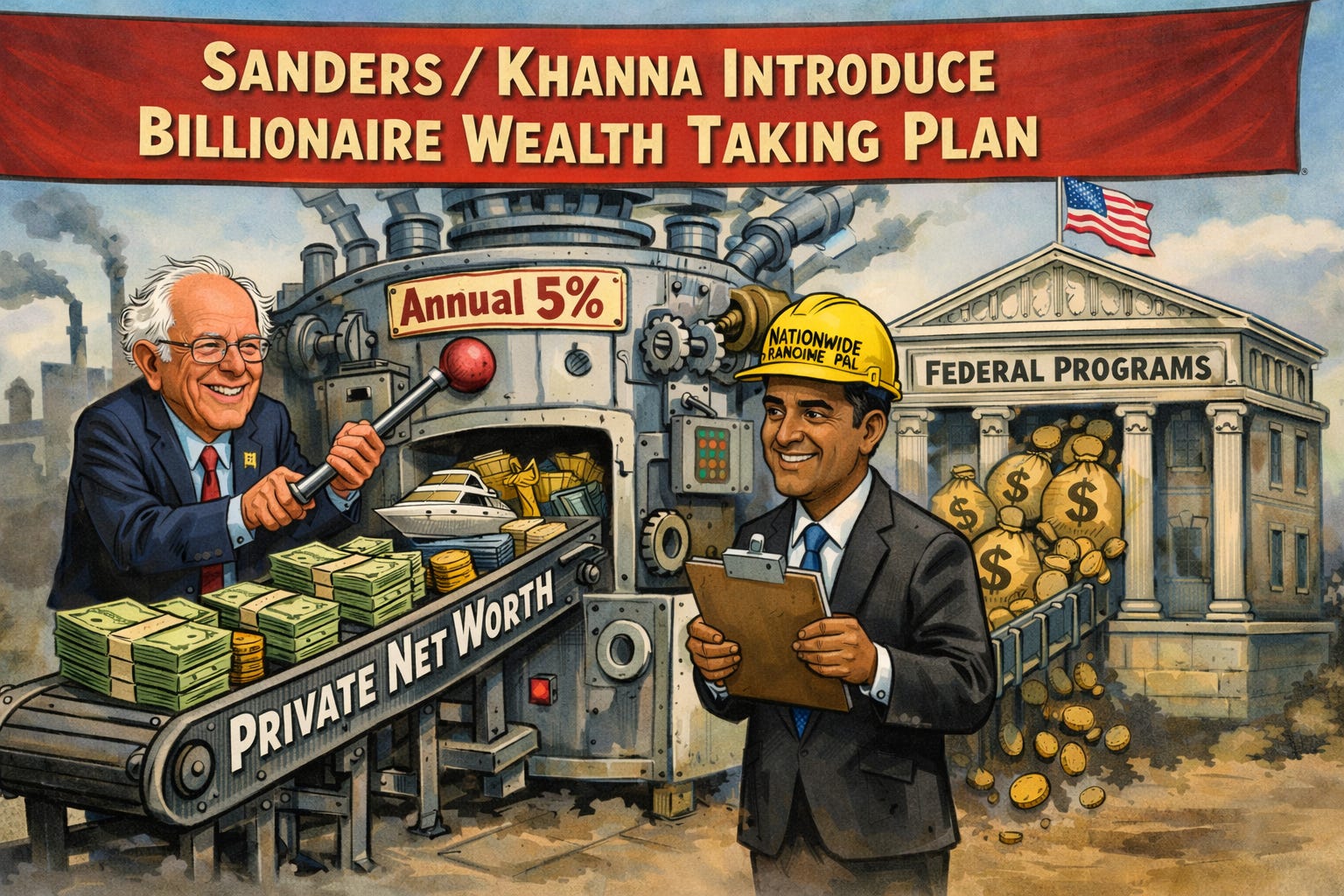
On Monday, Bernie Sanders unveiled a nationwide 5 percent annual wealth tax on billionaires — with California’s Ro Khanna leading the charge in the House.
The proposal would impose a 5 percent tax on net worth over $1 billion. Not income. Not capital gains. Net worth — companies, stock holdings, private equity stakes — assessed year after year. This is not a surcharge. It is a recurring federal claim on accumulated assets.
At the same time, California’s public employee unions are pushing a similar 5 percent wealth tax on net worth over $1 billion. But the state proposal is framed as a one-time levy. The Sanders–Khanna bill makes the taking permanent. The California measure calls it a single event.
That distinction matters — but only to a point. Once voters approve the principle that government can confiscate 5 percent of someone’s net worth simply for crossing an arbitrary threshold, the precedent is set. The political barrier collapses. The concept becomes normalized.
If Californians approve it once, future lawmakers won’t invent something new. They’ll build on what voters already accepted. In Sacramento politics, “one-time” revenue has a way of becoming part of the baseline. The federal proposal dispenses with gradualism entirely. It makes the 5 percent taking annual from the start.
Bad Revenue Assumptions
Supporters claim the nationwide tax would raise $4.4 trillion over ten years. That figure rests on an assumption that billionaires would avoid only about 10 percent of the tax through restructuring, relocation, or asset reclassification. That assumption defies reality.
High-net-worth individuals already structure assets aggressively under existing tax law. Add an annual wealth tax and assume minimal behavioral response? More realistic projections slash the revenue estimate. And even that ignores second-order effects. Reduce accumulated wealth and you reduce capital gains realizations. Reduce capital gains and you reduce income tax collections. The projected revenue erodes quickly.
Europe experimented with wealth taxes. France repealed its version after years of capital flight and investment decline. Other countries followed a similar path. The tax proved far easier to promise than to sustain.
California’s Risk Profile
Now consider California’s position. The state already depends heavily on a small fraction of ultra-wealthy residents for a disproportionate share of revenue. In strong market years, Sacramento enjoys surpluses. In downturns, deficits widen quickly. The revenue model is volatile by design. Layering a wealth tax onto that structure does not stabilize it. It amplifies the risk.
Khanna represents Silicon Valley — the innovation engine that drives much of America’s economic growth. Yet he is backing legislation that would impose an annual federal claim on the very ecosystem that fuels his district. He has suggested deferrals for startup founders whose wealth is tied up in illiquid stock. But that concession underscores the flaw. If a tax requires carve-outs to avoid punishing the companies driving innovation, the structure itself deserves scrutiny.
A Structural Shift
Let’s dispense with the slogan. Billionaires already pay massive income and capital gains taxes. This proposal isn’t about closing loopholes. It’s about creating a brand-new claim on private net worth — year after year. A recurring tax on net worth is fundamentally different. It assumes wealth is static, valuation is straightforward, and capital will remain stationary under mounting pressure. History suggests otherwise.
Both proposals are a 5 percent government claim on accumulated assets over $1 billion. One makes it permanent and annual. The other begins as a one-time levy but establishes the precedent that wealth itself is a target.
For generations, Americans have debated how much of what we earn the government should take. Sanders and Khanna are asking a different question: how much of what you own can the government claim?
So, Does It Matter?
If this becomes the new standard, the $1 billion threshold will not remain sacred for long. And sooner or later, everyone will start asking the same question:
When does the government stop taking a piece of what we earn — and start coming after what we have?
The uncomfortable reality is that much of today’s political left views proposals like this not as an endpoint, but as a starting point. When the appetite for expanding government and redistributing wealth grows more aggressive, even a 5 percent annual wealth tax can be framed as merely a step in the right direction.
Video Commentary Below The Paywall
For our paid subscribers, you get the something extra. Which on this column it’s some additional pithy commentary… Not a paid subscriber yet? That big red button will take you to a place to sign up for a free weeklong trial upgrade!
