


⏱️ 6 min
What’s Changing — and Why It Matters
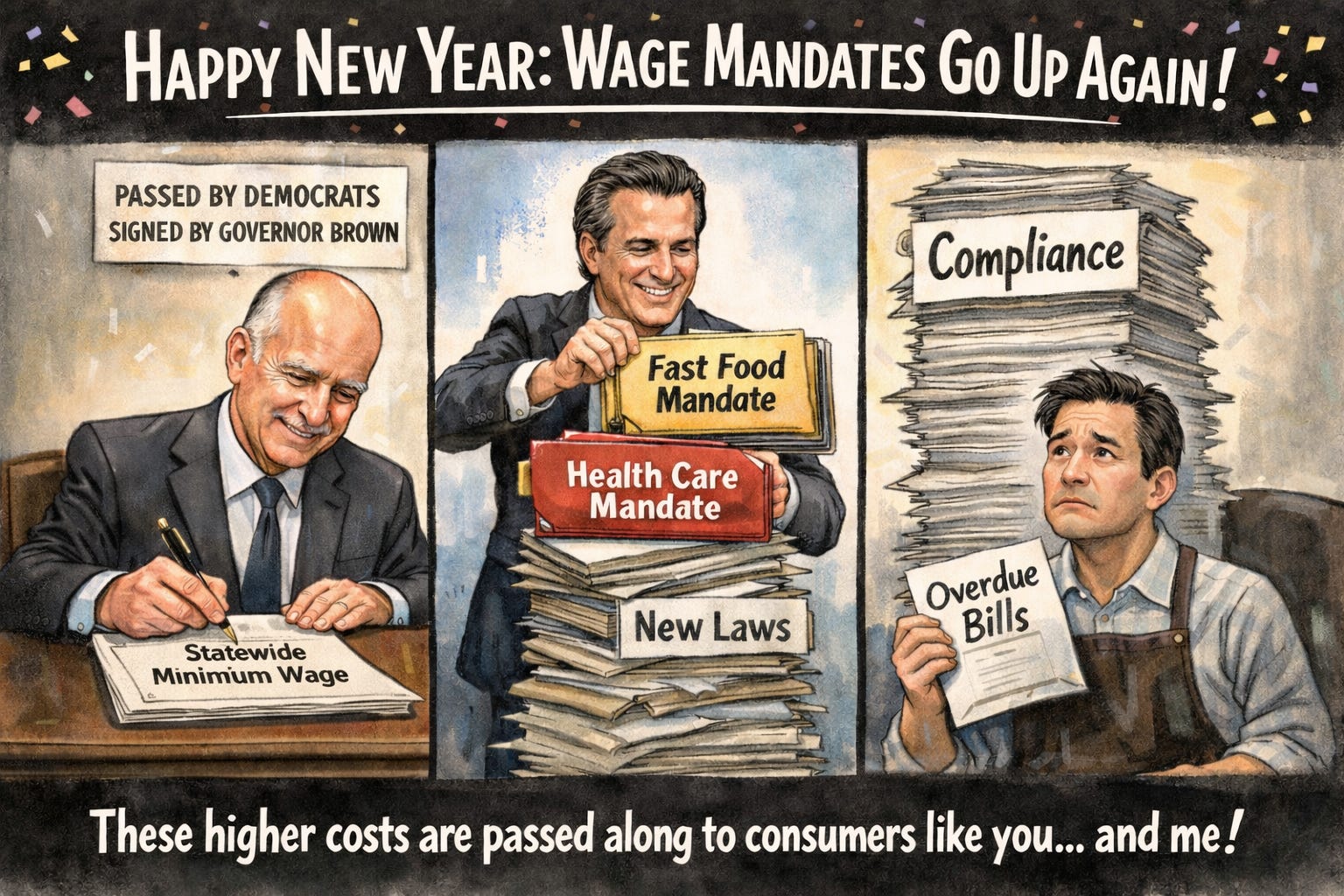
Tomorrow, January 1, California’s statewide minimum wage will increase to $16.90 per hour. This change happens automatically, based on an inflation formula set by legislative Democrats and signed into law by then-Governor Jerry Brown years ago. Supporters see it as routine, while others move on. But it is worth pausing for a moment to consider the folly of a mandated state wage minimum - especially one that keeps ratcheting up on autopilot.
This increase comes at a time when California no longer has just one minimum wage. The state has added several statewide wage mandates, and cities and counties have created their own local rules. The result is a system that is far more intrusive and carries greater consequences than most people realize.
Before explaining why this matters, it’s important to understand the current rules.
One State, Three Statewide Minimum Wages
California today effectively has three separate statewide minimum wages.
The first is the general minimum wage, which applies to most workers and increases automatically each year, which was passed by legislative Democrats last decade and signed by then-Governor Jerry Brown. The second is a $20-per-hour minimum wage for fast-food workers, created by legislative Democrats in 2024, signed by Governor Gavin Newsom, and enforced by a new state fast-food council. The third is a different wage system for health care workers, also passed by legislative Democrats and signed by Newsom, with rates that vary by facility and are gradually increasing to the mid-$20s per hour.
This approach of setting wages by sector is a clear change in public policy. Instead of allowing pay to reflect experience, productivity, and local conditions, the state is dividing the economy into selected sectors and setting wages through politics.
Fast food shows what can happen next. Restaurant owners across California are cutting hours, hiring less, raising menu prices, and relying more on automation. Once Sacramento starts setting wages for each industry, it opens the door to ongoing political battles over which group is next. But this is how state capitol corruption works — through policies that pick winners and losers. Then you see many campaign contributions to the majority party from those who want to win or avoid losing. But I digress…
Costs Don’t Disappear; They Get Passed Along
Health care will not escape the same dynamic. Higher required wages for hospital and clinic workers directly increase operating costs. These costs do not stay within the hospital. They appear in insurance premiums, co-payments, and out-of-pocket expenses, which families, employers, and taxpayers pay.
This is important in a state already struggling with high costs. Californians are paying more for housing, energy, transportation, and food. Health care is one of the most significant household expenses, and rising costs only make matters worse.
Supporters often argue that large health systems can absorb the additional costs. But there is no magic solution. Eventually, the bill is passed, and it usually falls on those who are less well-off.
Liberal-Run Local Governments Pile-On
State mandates are only part of the story. Many of California’s largest cities have adopted their own minimum wage ordinances, often well above the state floor. San Francisco, Berkeley, Oakland, Santa Monica, Los Angeles, and many other jurisdictions now require higher local wages.
The result is a confusing set of rules. A business operating in more than one city may face different minimum wages, different change schedules, and different enforcement rules. What is legal in one city might not be allowed just a few miles away.
It’s not surprising that many cities, most eager to adopt these rules, are also struggling with reduced business activity and higher prices. When employers cut back or leave, officials express concern, even as they continue to add new requirements.
The Problem Sacramento Refuses to Address
California’s focus on minimum wage rules reflects a more profound reluctance to address the underlying policies that make life less affordable.
Raising wages by law does not lower rent or reduce electricity bills. It does not expedite permitting or make it easier to start a business. In many cases, it does the opposite by raising costs and discouraging investment.
That’s why minimum wage increases often fail to provide lasting help. Higher prices, fewer hours, or fewer job opportunities quickly cancel out any short-term gains. Those most affected are usually those entering (or trying to enter) the workforce, such as young workers, immigrants, and those with limited experience.
A Patchwork with Consequences
Taken together, California’s minimum wage system has become layered, fragmented, and political. Automatic statewide increases, industry-specific mandates, and local ordinances now operate concurrently, making outcomes harder to measure.
This confusion is convenient for politicians. They can celebrate higher wages while avoiding responsibility for the results. Meanwhile, workers and consumers deal with the consequences, whether anyone admits it or not.
So, Does It Matter?
This matters because wages are tied to the economy that supports them. This system did not happen by accident. Legislative Democrats created it, Governor Jerry Brown set up the framework, and Governor Gavin Newsom has expanded it with industry-specific rules that reach further into the private economy.
California’s approach treats paychecks as symbols instead of signals, even as life becomes less affordable. A stronger economy comes from growth, opportunity, and fewer barriers to entry, not from constantly changing the rules for jobs. Until policymakers acknowledge this reality, Californians will continue to pay more, have fewer choices, and face a job market shaped more by politics than by real opportunity.
If Governor and ersatz President Newsom really cares about affordability, he would demand that the legislature place a repeal of wage mandates on his desk for his signature. But I think the Governor is more focused on pandering to a few thousand prospective delegates to the 2028 Democratic Presidential Nomination Convention than on truly making life in this state more affordable.
Want More?
If you want a succinct read on why government wage mandates are a bad idea, you can read my column from last August, Issue Tool Kit: The Top Eight Reasons Why Minimum Wage Laws Are a Terrible Idea.
Below the paywall are some videos; others, who are much smarter than I, are also explaining why wage mandates are harmful.
Oh yeah, this is our last scheduled post for the year — until Monday, actually. Now, will I post anything before then? Probably - this is my hobby! But I reserve the right to spend quality time with the family and recharge my batteries!
Pro Tip: The SALE button offers a significant discount (25%). The free trial does not!
