

Artificial Intelligence Is Already Embedded In Teenage Life And The New Pew Data Shows It - These Kids Deserve Protection
Absorb This New Data -- And Let's Think About The Exposure Our Kids Have To This Technology

Our afternoon content is either exclusively for paid subscribers or has extra content just for those of you who have upgraded. Today, there is some interesting extra data below the paywall for our paid subscribers. You can listen to this content on your favorite podcasting app. Search for So, Does It Matter? Spoken.
⏱️ 6 min read
The Data And The Policy Question
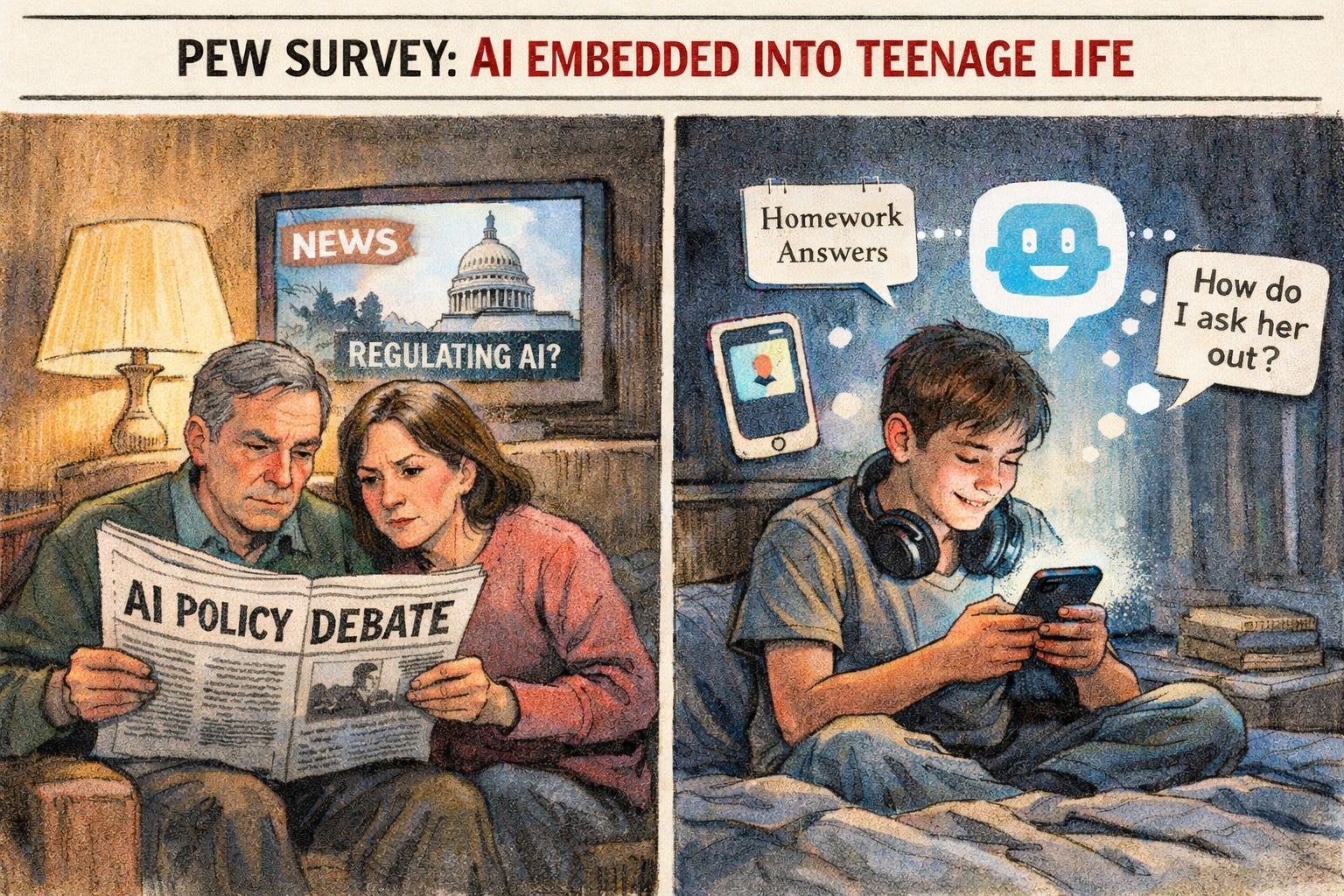
Pew Research Center issued a new report yesterday titled "How Teens Use and View AI." It provides one of the clearest snapshots yet of how artificial intelligence is interacting with American teenagers. These are not forecasts about the future. They are measurements of what has already happened.
As you read these numbers, the policy question should not be abstract. The real question is what we are doing, in terms of public policy, to protect kids while persuasive, conversational systems rapidly integrate into adolescent life.
According to Pew, 64% of U.S. teens ages 13–17 say they have ever used an AI chatbot. Nearly two-thirds of American teenagers have already interacted directly with tools such as ChatGPT, Gemini, or Meta AI. That is no longer early experimentation. It is widespread exposure.
Pew also reports that about three-in-ten teens say they use AI chatbots daily. When roughly 30% of a generation uses a tool every day, that tool begins to influence routines and expectations.
Where Integration Is Happening
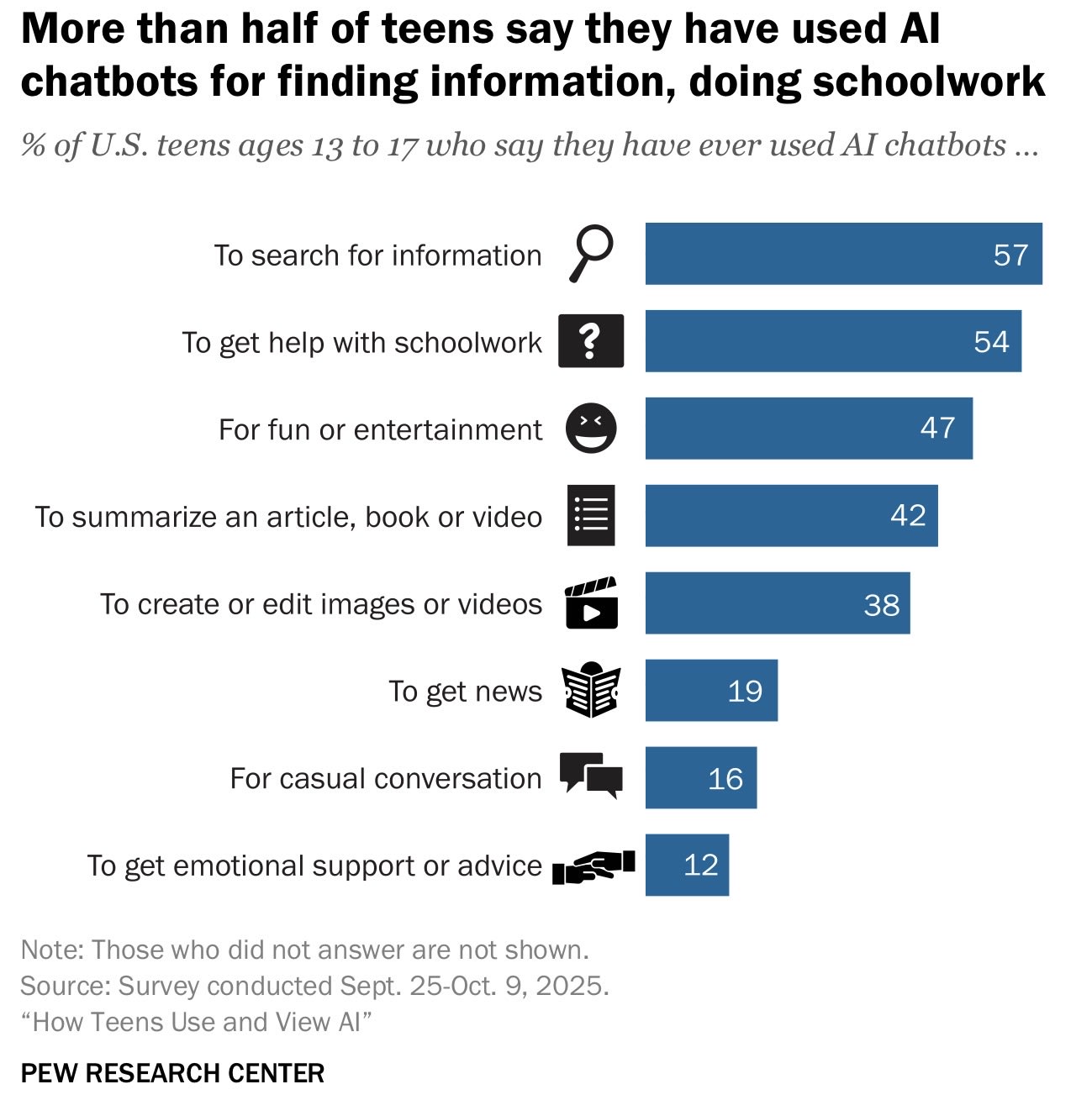
The report details how teens report having used these systems. 57% say they have used chatbots to search for information. 54% say they have used them to get help with schoolwork or assignments.
47% report using chatbots for fun or entertainment. Roughly four in ten say they have used them to summarize content or to create and edit images and videos.
19% say they have used chatbots to get news. Sixteen percent say they have used them for casual conversation. 12% report using chatbots for emotional support or advice.
These figures describe a broad footprint. AI use among teens is not confined to entertainment or novelty tasks. It reaches into information gathering, academic assistance, creativity, news consumption, and, for a meaningful minority, personal reassurance.
The Academic Shift
The schoolwork number deserves careful interpretation. More than half of teens say they have used chatbots to help with assignments, research, explanations, or problem-solving. Pew does not claim that students are universally submitting fully AI-generated work, but it does document that AI has entered the academic workflow for most teens.
The report also measures the degree of reliance. 10% say they do all or most of their schoolwork with help from a chatbot. 21% say they use chatbots for some assignments. 23% say they use them a little. 45% percent say they have not used chatbots for schoolwork at all.
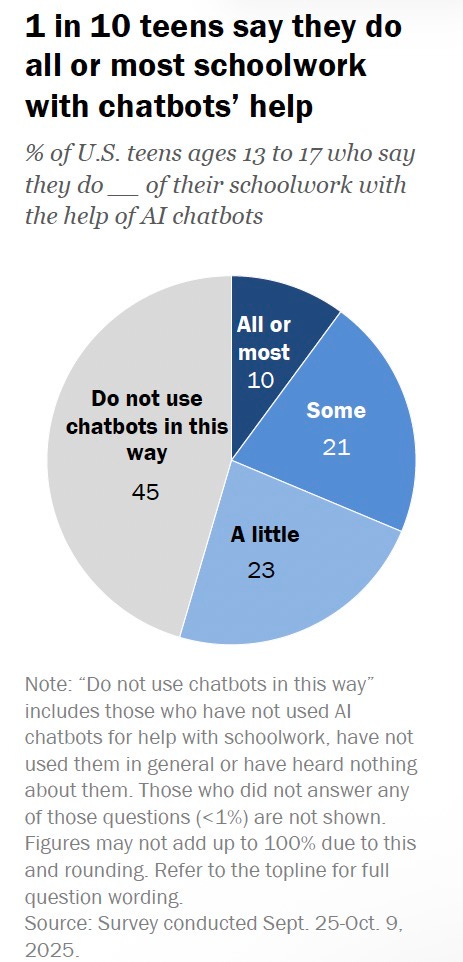
Even with nuance, one in ten reporting heavy reliance is significant. That represents millions of students saying AI plays a primary role in how they complete school tasks. Among those who use it “a little” or “for some assignments,” the presence of AI as a routine aid still reflects a cultural shift.
Behavior tends to change before institutions do. By the time policymakers decide how to respond, norms may already feel established.
The Broader Behavioral Layer
The cumulative pattern is what matters. 64% have ever used AI chatbots. About thirty percent report daily use. 54% have used them for schoolwork. 19% have used them to get news. Twelve percent have used them for emotional support.
Those numbers describe more than isolated experimentation. They describe a generation incorporating AI into how they gather information, approach assignments, consume media, and occasionally seek advice.
Artificial intelligence is often discussed as a workforce tool or a geopolitical competition issue. The Pew data show something more immediate. AI is already part of the cognitive environment in which American teenagers are developing.
When systems are designed to be conversational, responsive, and persuasive, scale matters. And scale, according to Pew’s data, is already here.
So, Does It Matter?
A technology used by nearly two-thirds of teens, accessed daily by nearly one-third, and integrated into schoolwork, information, and emotional habits, is not experimental. It is embedded during one of the most formative stages of life.
These survey results should serve as a clear warning to lawmakers — especially here in California, where many of these companies operate and where regulatory standards often begin. The Legislature cannot treat this as a distant innovation debate while millions of minors are already interacting daily with persuasive, adaptive systems designed to influence behavior. Strong, enforceable guardrails are not anti-technology; they are pro-child.
Artificial intelligence will continue advancing. The only open question is whether public policy will keep pace — deliberately and seriously — with protecting children as a priority rather than an afterthought.
One More Key Chart (Okay, Two)
There’s one more chart below the paywall — and it may be the most revealing one in the entire survey. It shows how teens perceive AI use in their own schools, which could matter even more than how often they personally use it. If you appreciate seeing the data laid out clearly, this is one you won’t want to miss.
