

America At 250: The Question Before Us
As America reaches this historic anniversary, the great challenge is not whether the nation deserves saving, but whether we still have the confidence to preserve it.

Our morning content is free for all subscribers and guests! Usually our afternoon content is behind a paywall… If you are not yet a paid subscriber, consider upgrading — you are missing a significant portion of what we produce each week, and your support makes it possible. If you want to get it all and support my efforts, please consider a paid subscription!
RIGHT NOW WE ARE HAVING AN AMAZING JULY 4TH SALE FOR PAID MEMBERSHIPS! $55 A YEAR - FOREVER. TAKE THE PLUNGE! BIGGEST SALE OF THE YEAR. SALE ENDS AT MIDNIGHT TONIGHT.
You can also listen to this post on our podcast feed, So, Does It Matter? SPOKEN. It is available on your favorite podcast app. And you can listen to it here.
🕒 5 min read
The Greatest Experiment
Rights came first. The government came second.
That was the revolutionary proposition of July 4, 1776. A small collection of colonies did not merely declare independence from a king. They rejected an idea that had governed most of human history: that power naturally belonged to rulers, and liberty existed only at the state's pleasure.
Two hundred and fifty years later, that remains among the most consequential ideas ever introduced into human civilization.
The American experiment has never been perfect. We have endured civil war, corruption, injustice, economic collapse, social upheaval, and deep national division.
And yet the experiment endured.
More than endured, it flourished. No nation in history has generated more prosperity, produced more innovation, protected more individual liberty, created broader opportunity, or offered more peaceful avenues for political change than the United States of America.
That is not a slogan. It is the verdict of history. The point is not that America has always lived up to her creed. It is that her creed gave every generation a standard by which to judge failure, demand reform, and widen the circle of liberty.
Conflict Is Not Failure
Political conflict is not new in America. The Founders fought over the structure of the republic. Federalists and Anti-Federalists fought over the Constitution. Lincoln and Douglas battled over the meaning of the Union. Roosevelt and Reagan each forced the country to argue anew over government, liberty, security, and responsibility.
Those disagreements were not signs of failure.
They were signs of freedom.
A free people will argue. A self-governing people must argue. That is not a weakness of the American system. It is the American system.
But beneath those arguments lay something larger and more important: a broad agreement on the legitimacy of the American project itself. Americans disagreed about the road. They still agreed on the destination.
For generations, Democrats and Republicans, liberals and conservatives, business leaders and labor unions argued over how best to strengthen the country, expand opportunity, and preserve liberty for those who would come after them. The assumption was not that America was perfect. The assumption was that America was fundamentally good and fundamentally worth preserving.
That consensus feels weaker today.
The Deeper Divide
The danger is not that America has a left wing. A great republic can survive sharp ideological differences. It always has.
The danger is that a growing part of the left no longer treats constitutional liberty as the referee, but as one more obstacle to be overcome.
Consider a concrete example. In 2024, California enacted AB 1955, a law that prohibited school districts from requiring staff to notify parents when their child began identifying as a different gender at school. The state positioned itself between parent and child, treating the family not as the foundation of civil society but as a potential threat requiring state management. A federal court struck down the law. The Supreme Court upheld the injunction. But the instinct behind the law is what matters here: the assumption that government professionals are better stewards of a child’s welfare than the child’s own parents, and that constitutional rights — in this case, the fundamental right of parents to direct their children’s upbringing — are obstacles to be circumvented rather than boundaries to be respected.
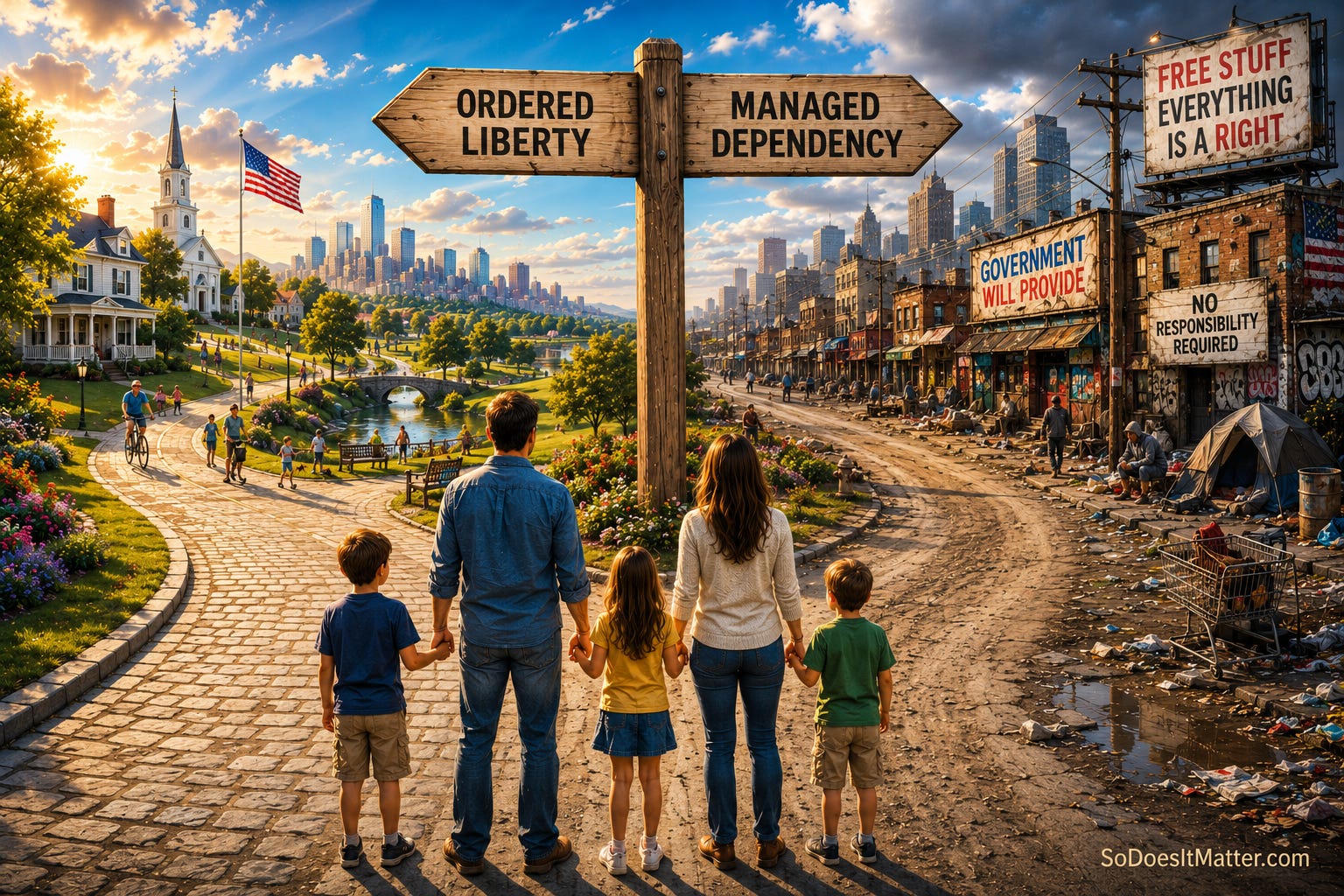
The American understanding held that rights came before government, liberty required responsibility, and citizens learned self-government through family, faith, local institutions, voluntary associations, and civic life. The rival view treats rights as permissions supervised by government, looks to the state for security and meaning, and relocates moral authority from citizens and communities to administrators and courts. It is more comfortable with dependency than self-reliance, more suspicious of merit than mediocrity, and more willing to use state power to impose its moral judgments.
This is not merely an argument about tax rates, spending levels, or the size of any particular program. Those are ordinary political disputes. They matter, but they are not the deepest argument.
The deeper argument is about first principles: Where do rights come from? What is government for? What does freedom require of citizens? Can ordered liberty survive if large factions no longer believe ordered liberty is the goal?
That is the crossroads.
The Warning Before Us
Tocqueville warned that democratic peoples might gradually surrender liberty, not to kings or generals, but to a paternalistic state offering comfort, security, and administration in exchange for responsibility. He envisioned “an immense and tutelary power” that would cover society “with a network of small, complicated rules, minute and uniform, through which the most original minds and the most energetic characters cannot penetrate.” It would not tyrannize, he wrote. It would simply soften, bend, and direct — until a free people became “nothing better than a flock of timid and industrious animals, of which the government is the shepherd.”
That warning no longer feels theoretical.
We see versions of it whenever public officials treat constitutional limits as inconveniences rather than restraints. We see it in laws designed to circumvent parental authority, in regulatory schemes that make lawful activity progressively more difficult, and in administrative structures that transfer decisions from citizens to experts, from communities to bureaucracies, from the governed to the governing.
None of these disputes alone defines the country. But together they point in the same direction: away from the citizen and toward the state; away from persuasion and toward compulsion; away from ordered liberty and toward managed life.
A people can lose the habits of self-government long before they formally lose the institutions of self-government. They can still have elections, courts, legislatures, and constitutions, while slowly transferring more and more of life’s decisions to bureaucracies, experts, mandates, and centralized power.
That is not the American inheritance.
America was built on a hard-headed understanding of human nature. Government was necessary because man is imperfect. But the government was also dangerous for the same reason. That is why power had to be limited, divided, checked, and constantly watched by a free people.
This is where the modern ideological divide becomes so serious. If government is the primary instrument for remaking society, limits on government become obstacles. Speech must be managed. Religious liberty becomes a barrier. Parental authority becomes negotiable. Economic freedom becomes suspect. Merit becomes inequity. Responsibility gives way to administration.
That is not reform.
That is a different vision of America.
So, Does It Matter?
America has survived far worse than our present moment — civil war, world wars, depression, assassination, terrorism, and countless predictions of imminent decline.
But confidence is not the same as complacency. Every generation inherits the country in imperfect condition. Every generation must decide whether to preserve it, improve it, and pass it on.
The Fourth of July is not merely a celebration of events that occurred in 1776. It is an annual renewal of faith in the proposition that free people are capable of governing themselves.
That proposition remains worth defending.
Not because America is perfect. But because no nation in history has done more to advance the cause of human liberty, human dignity, and human flourishing.
As we celebrate this historic anniversary, the question before us is not whether America deserves saving. The question is whether we still possess the confidence, gratitude, and courage necessary to preserve the remarkable inheritance we were given.
I believe we do. But belief is not enough.
Two hundred and fifty years ago, a small band of citizens declared that rights came first and government came second. That remains the most radical proposition in the history of human self-governance. It falls to us — as it has fallen to every generation — to prove it can endure.
- JSF