

AB 1821 Would Make State And Local Government More Secretive
The California Public Records Act belongs to the public, not government agencies seeking fewer questions and less scrutiny.

Our morning content is free for all subscribers and guests! Usually our afternoon content is behind a paywall… If you are not yet a paid subscriber, consider upgrading — you are missing a significant portion of what we produce each week, and your support makes it possible. If you want to get it all and support my efforts, please consider a paid subscription!
You can also listen to this post on our podcast feed, So, Does It Matter? SPOKEN. It is available on your favorite podcast app. And you can listen to it here.
⏱️ 5 minute read
The Public Owns The Records
The California Public Records Act is not complicated in concept. Government records are paid for by the public, created by public agencies, maintained by public employees, and used to conduct the public’s business. They do not belong to politicians, bureaucrats, agency heads, public employee unions, or taxpayer-funded agencies. They belong to the people.
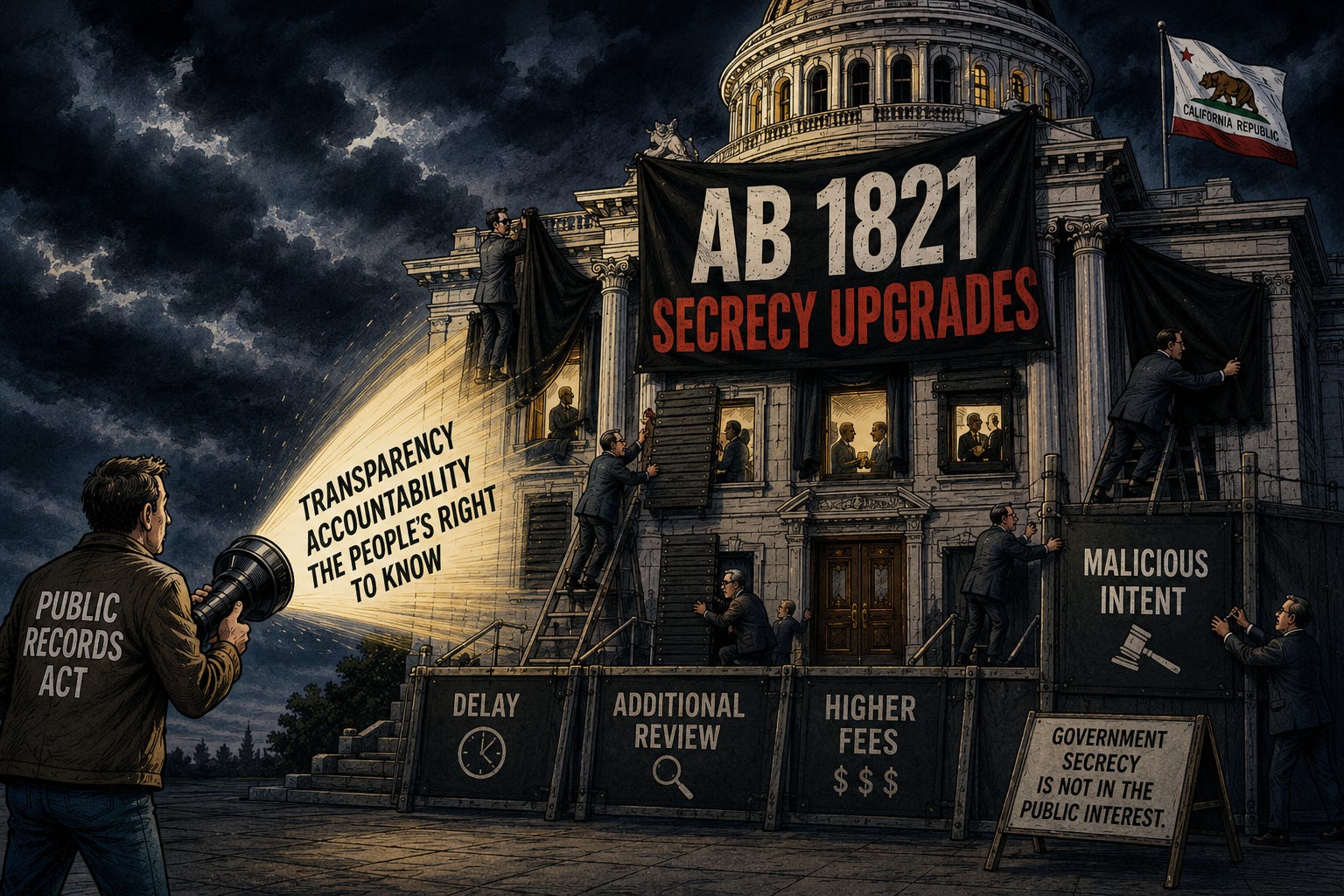
That is why Assembly Bill 1821 deserves to be called out plainly. This bill would make it more difficult to obtain public records by giving agencies more room to delay responses, letting them reject requests they claim were not properly submitted, allowing new charges for search and retrieval in some cases, and permitting agencies to go to court against requesters they accuse of acting with malicious intent.
I do not buy the spin that this is just about administrative burden. If government agencies have a narrow problem with abusive records requests, then write a narrow bill. AB 1821 is not narrow. It gives government more leverage over citizens seeking public information, and in my book that is exactly backwards.
For decades, journalists, taxpayer advocates, community groups, and ordinary citizens have relied on public records requests to uncover waste, misconduct, sweetheart deals, excessive compensation, and government mistakes that otherwise might never have come to light. Government does not usually volunteer the embarrassing stuff. Somebody has to go looking for it.
Who Is Really Driving This?
The most revealing aspect of AB 1821 is not just what it does, but who wants it. The California State Association of Counties and the League of California Cities are backing the legislation. These are organizations that represent the very public agencies Californians are trying to scrutinize through the Public Records Act.
Think about that. The institutions subject to public records requests are lobbying Sacramento for legislation that would make public records requests more difficult. That should set off alarm bells for anyone who believes government should answer to the people, not the other way around.
Public records laws were never created to make life easier for government officials. They were created to protect citizens from government secrecy. Of course agencies would prefer fewer requests, fewer deadlines, fewer disclosures, and fewer people examining how decisions are made. Responding to records requests takes time. It consumes resources. It can expose mistakes. It can create embarrassing headlines. Too bad.
I have no patience for the argument that government convenience should override public access. If a city council, county board, school district, or agency is spending public money and exercising public power, citizens have every right to ask what is going on. When organizations representing government agencies seek new authority to delay, restrict, or discourage public records requests, the obvious question is: who benefits? Not the taxpayer.
None of this comes out of nowhere. Californians have already watched the Legislature play hide-the-ball with the now roughly $1.2 billion Capitol Annex project. Reporters, with a special no to KCRA’s Ashley Zavala, have tried to obtain basic cost information and supporting records, only to be told that key documents will remain secret until construction is completed.
And here is the part that makes it even richer: one of the lawmakers overseeing that project is Assemblymember Blanca Pacheco, the author of AB 1821. Californians can decide for themselves whether it is merely a coincidence that a lawmaker tied to one of Sacramento’s most glaring transparency fights is now carrying a bill that would make public records harder to obtain.
Transparency Is Not A Theory
This is not some abstract debate about paperwork. Transparent California has spent years using public records requests to obtain government compensation records from agencies across the state. That work has helped expose questionable compensation practices, excessive payouts, reporting irregularities, and other matters directly affecting taxpayers.
In a letter opposing AB 1821, Todd Maddison, Director of Research for Transparent California, explained that his organization has used the California Public Records Act to obtain millions of government compensation records. One example involved a school superintendent reportedly receiving compensation exceeding $700,000 annually in a district where most students qualified for free or reduced-price lunches.
In another case, Transparent California uncovered a reported $2 million payout in Los Angeles County that had not been properly reflected in official reporting. These discoveries were not made because government voluntarily highlighted them. They were made because somebody asked questions, pulled records, compared numbers, and noticed when something did not add up.
That is how accountability works in the real world. The public rarely knows beforehand which records request will expose waste, abuse, or mismanagement. Most requests uncover nothing remarkable. But occasionally one reveals something taxpayers deserve to know, and that is exactly why government should not be given broader power to slow-walk, price out, or intimidate the people asking.
The Dangerous Shift In Thinking
What concerns me most about AB 1821 is the mindset it reflects. Increasingly, some public officials appear to view public records not as information belonging to citizens, but as information belonging to government. Transparency becomes a burden, oversight becomes harassment, questions become inconveniences, and accountability becomes optional.
The most troubling provision in the bill may be its treatment of requests deemed to involve “malicious intent.” Government agencies should not be in the business of judging why citizens are seeking public records. A journalist investigating spending practices, a taxpayer activist examining public contracts, a political opponent looking into an elected official’s decisions, and a neighborhood resident questioning a development project all have the same right to seek information.
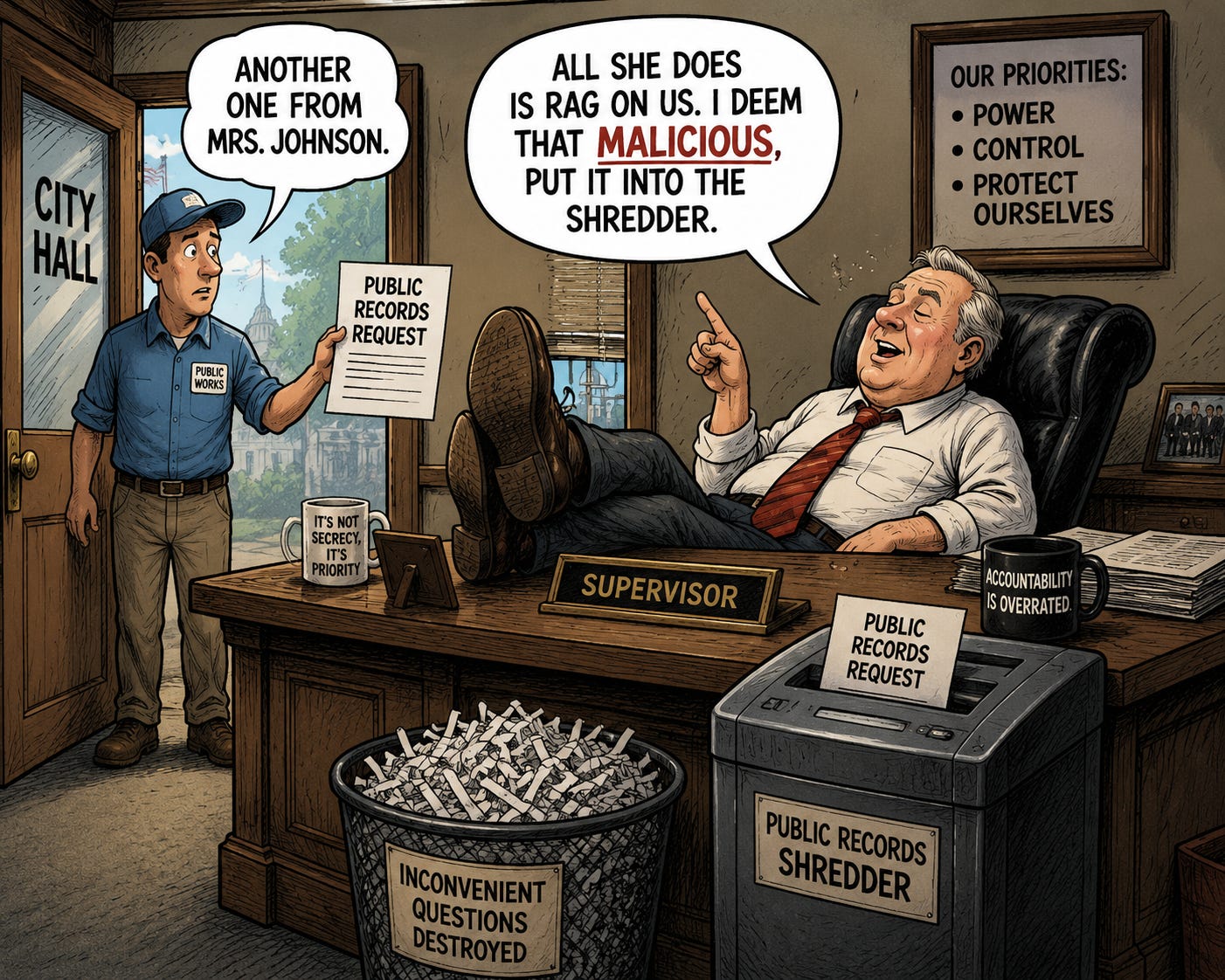
The law should focus on whether records are public, not whether government approves of the requester’s motives. Once government acquires authority to decide which requests are sufficiently worthy, transparency becomes vulnerable to politics. I do not want government agencies deciding whether a citizen’s curiosity, persistence, or skepticism is acceptable.
So, Does It Matter?
James Madison understood the danger nearly two centuries ago. “Knowledge will forever govern ignorance,” he wrote, and citizens who wish to govern themselves “must arm themselves with the power which knowledge gives.”
The California Public Records Act is one of those tools. At a time when trust in government institutions is already strained, California should not be making government more secretive. The people pay the bills. The people elect the officials. And the people own the records.
This bill should die in the legislature. And those that vote for it are not on the side of the people, and transparency.
At this point call your State Senator (this bill has passed the Assembly with both Democrat and Republican votes!) - urge them to vote no!