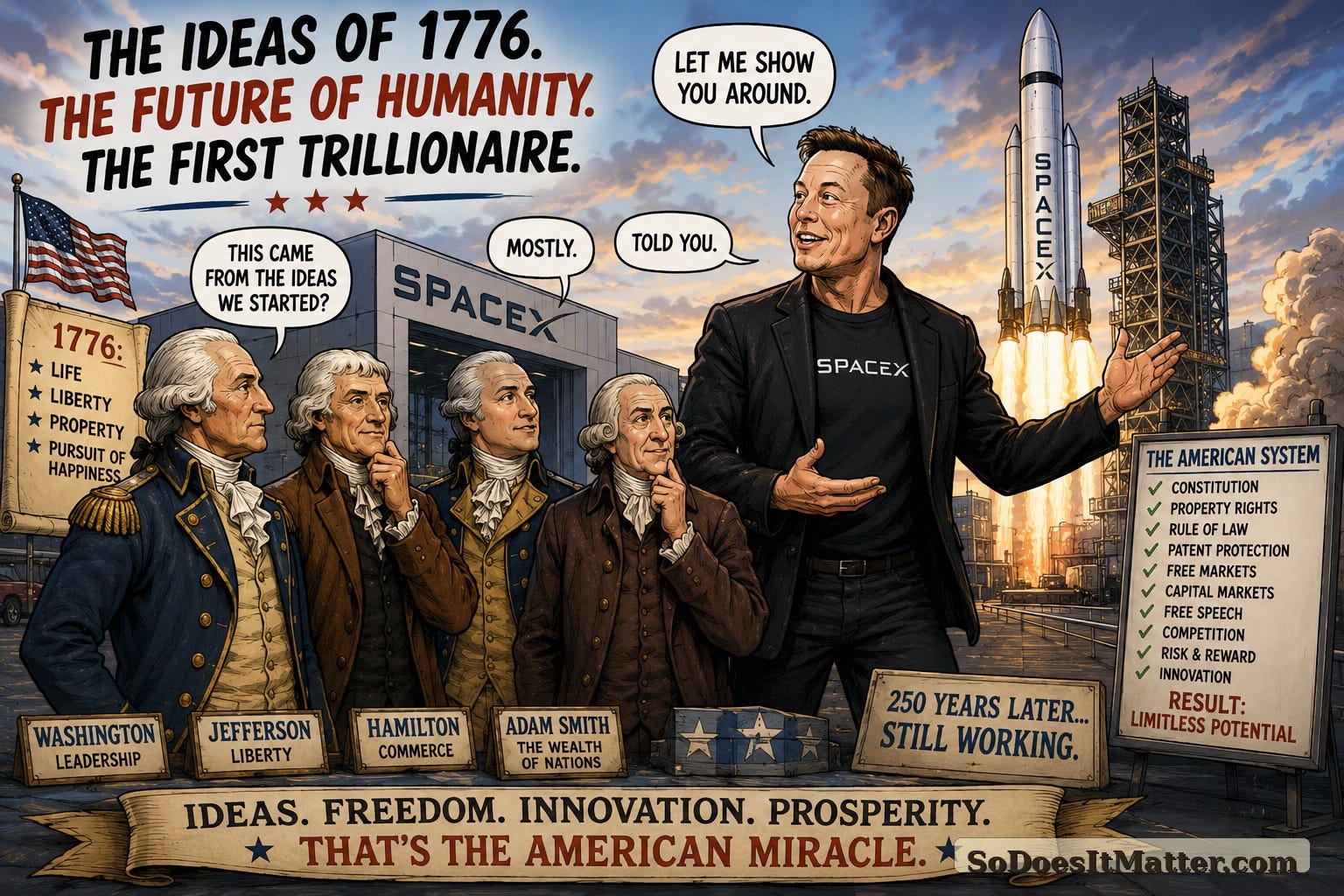
A Trillionaire, And The American Miracle
The world’s first trillionaire arrives as America and Adam Smith’s The Wealth of Nations both approach their 250th anniversary.
[REMINDER, WE ARE ON A VACATION SCHEDULE THIS WEEK]
Our morning content is free for all subscribers and guests! Usually our afternoon content is behind a paywall, but not when I am previewing a California Post column… If you are not yet a paid subscriber, consider upgrading — you are missing a significant portion of what we produce each week, and your support makes it possible. If you want to get it all and support my efforts, please consider a paid subscription! There is exclusive content below the paywall on this post…
You can also listen to this post on our podcast feed, So, Does It Matter? SPOKEN. It is available on your favorite podcast app. And you can listen to it here.
⏱️ 5 minute read
“The uniform, constant, and uninterrupted effort of every man to better his condition, the principle from which public and national, as well as private opulence is originally derived, is frequently powerful enough to maintain the natural progress of things toward improvement, in spite both of the extravagance of government and of the greatest errors of administration.”
— Adam Smith, The Wealth of Nations (1776)
More Than A Number
As America approaches its 250th birthday, the world is about to witness something that would have been unimaginable to the Founders.
The first trillionaire.
Thanks largely to the extraordinary success of SpaceX, Tesla, and xAI, Elon Musk has crossed a threshold no human being has ever reached before. Many people see that milestone and instinctively recoil. They see inequality, excess, or concentrated wealth. They will say this is a story about one man’s greed, or about a system rigged in his favor.
I see something else.
I see evidence that the American experiment is still working.
The real story is not Elon Musk. The real story is that a nation founded 250 years ago created the conditions that made a trillionaire possible. The story is not one man’s fortune. The story is the prosperity, innovation, and wealth creation that produced it.
1776 Changed The World
The timing is almost too perfect.
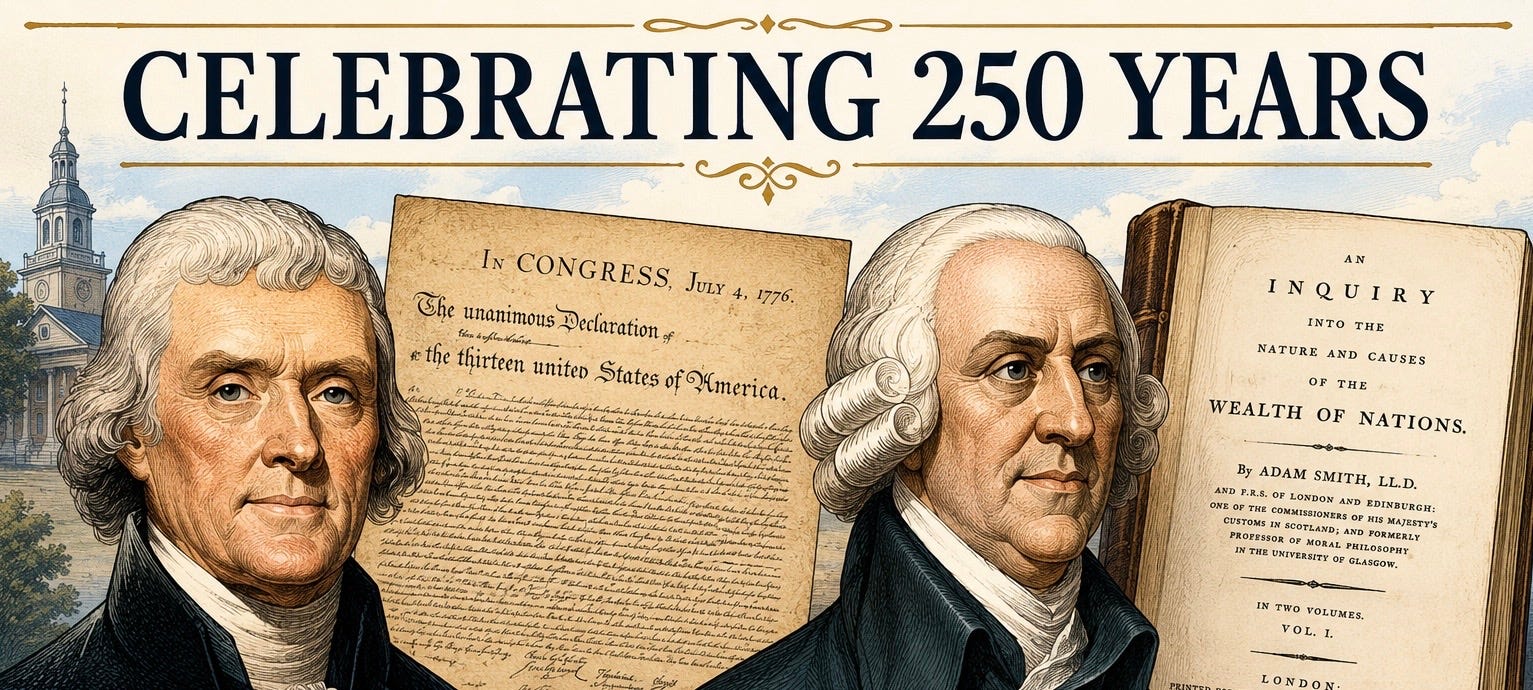
In 1776, America’s Founders launched a political revolution with the Declaration of Independence. That same year, Adam Smith published The Wealth of Nations and helped launch an economic revolution.
Smith asked a simple question: Why are some nations rich while others remain poor?
His answer challenged centuries of conventional wisdom. Prosperity did not come primarily from kings, aristocrats, monopolies, or government control. It came from free people producing, trading, investing, inventing, and improving their condition.
America became history’s greatest test of that idea.
The United States rejected the rigid mercantilist system that dominated much of Europe and instead embraced property rights, entrepreneurship, competition, and opportunity. It was an imperfect experiment, but over time it generated levels of prosperity that would have been unimaginable in the eighteenth century.
The American Formula
America’s success was not an accident.
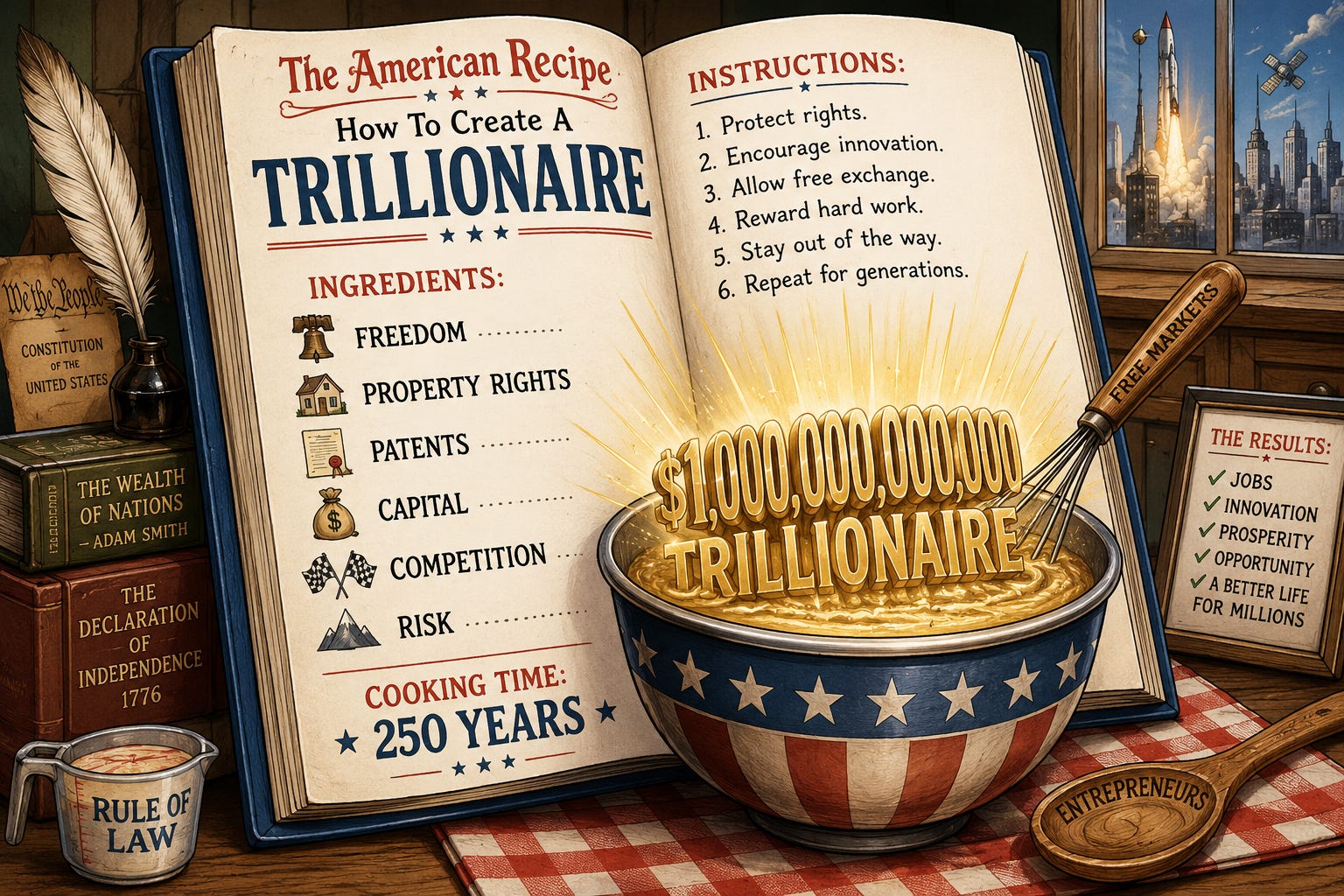
The Constitution protected property rights. The rule of law encouraged investment. The Patent Act of 1790 gave ordinary citizens the ability to protect and profit from their inventions. America created institutions that rewarded innovation rather than inherited privilege.
People came from around the world because they believed they could build something here.
Many did.
From the industrialists of the nineteenth century to the technology entrepreneurs of the twenty-first, generations of Americans transformed ideas into companies, companies into industries, and industries into prosperity.
Alexander Hamilton understood this early in the Republic’s history when he wrote in the opening of Federalist #12…
“The prosperity of commerce is now perceived and acknowledged by all enlightened statesmen to be the most useful as well as the most productive source of national wealth.”
More than two centuries later, Hamilton’s observation looks remarkably prescient. It also looks like a prediction that was tested — and confirmed — by two and a half centuries of American economic history. Nobel Prize-winning economist Milton Friedman made a similar point in his 1962 book Capitalism and Freedom…
“The great advances of civilization, whether in architecture or painting, in science or literature, in industry or agriculture, have never come from centralized government.”
Looking at America’s most valuable companies today, it is hard to disagree.
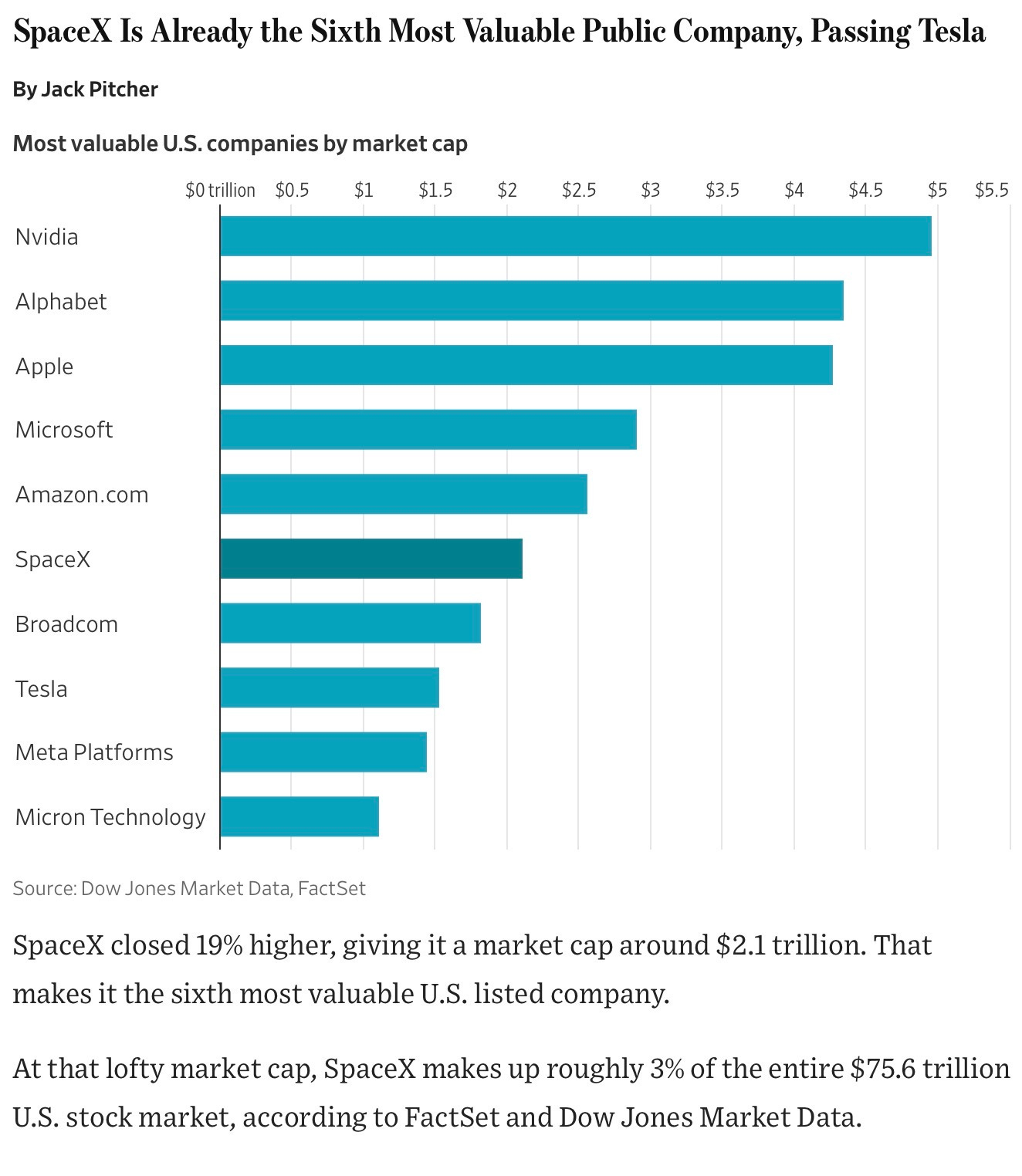
The chart tells the story visually. America’s most valuable companies are not relics of inherited privilege. Nvidia, Apple, Microsoft, Amazon, Alphabet, Tesla, and SpaceX — which completed its historic IPO just this week — are companies built around chips, software, logistics, search, electric vehicles, rockets, satellites, and communications — alongside xAI, Musk’s artificial intelligence company now merged with SpaceX. That is modern wealth creation: ideas becoming products, products becoming companies, and companies becoming engines of national prosperity.
Millions Of Winners
Critics often talk about wealth as though it were a fixed pie.
It isn’t. That assumption — that every dollar earned at the top is a dollar extracted from the bottom — is the foundational error of almost every progressive economic argument.
Adam Smith understood this as well…
“What improves the circumstances of the greater part can never be regarded as an inconvenience to the whole.”
SpaceX employs tens of thousands of workers. Tesla employs tens of thousands more. Investors, retirement accounts, suppliers, contractors, and consumers have all benefited from the success of these companies.
The wealth was not dug out of the ground.
It was created.
The existence of a trillionaire does not mean a trillion dollars was taken from everyone else. It means companies were built that millions of people voluntarily chose to support as customers, employees, suppliers, or investors.
A rising tide lifts all boats.
That old saying survives because it contains a profound truth. The remarkable story is not that Musk became richer than John D. Rockefeller. The remarkable story is that ordinary Americans today enjoy technologies, conveniences, and opportunities that even Rockefeller could not have imagined.
So, Does It Matter?
It cannot be left out that Musk’s companies, like many major American companies, have benefited from government incentives and contracts. But subsidies do not create trillion-dollar companies. Innovation, execution, customers, investors, and markets do.
For most of human history, the richest people became rich because they inherited kingdoms, controlled armies, or enjoyed political privilege.
Today, people become rich by creating products and services that millions voluntarily choose to buy.
That is progress.
As America approaches its 250th birthday, it is worth remembering that the Declaration of Independence and The Wealth of Nations arrived in the same remarkable year. One launched a political revolution. The other helped launch an economic one.
Together they helped create a society in which free people could accomplish extraordinary things.
The world’s first trillionaire is not the miracle.
The miracle is that 250 years later, the ideas of 1776 still work.
Below the paywall are a few extra political cartoon images for our paid subscribers! Ok, one more for everyone. Then three MORE under the paywall…