

A Governor’s Candidate Forum Worth Watching
A surprisingly substantive long-form housing discussion gave voters a much clearer look at how California’s Democratic gubernatorial candidates think about this issue. The Republicans were absent.


Our afternoon content is typically for paid subscribers, but I’m making this one available to all readers. But please consider supporting my efforts with a free or paid subscription!
🕗 8-minute read
The Forum California Actually Needed
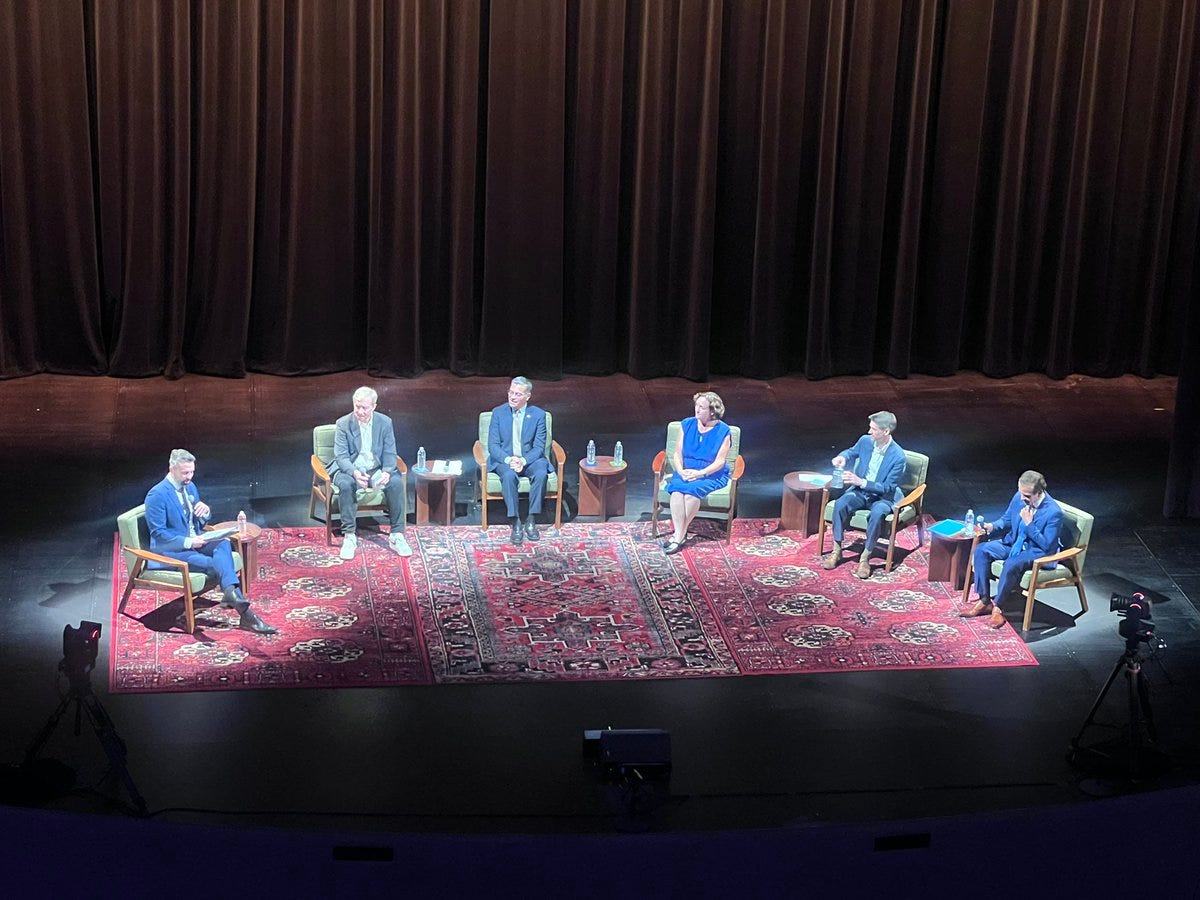
Earlier this week, Ezra Klein of The New York Times moderated a lengthy housing policy forum in Oakland hosted by a coalition that included the Housing Action Coalition, UC Berkeley’s Turner Center for Housing Innovation, the San Francisco Foundation, and The Ezra Klein Show. The event featured the five leading Democratic candidates for governor: Tom Steyer, Xavier Becerra, Katie Porter, Matt Mahan, and Antonio Villaraigosa.
The forum ran roughly 90 minutes to nearly two hours, depending on how you count the intro and closing portions. And while I disagreed with a lot of what was said, the format itself was exactly the kind of thing this governor’s race desperately needs more of.
The two leading Republican candidates, Chad Bianco and Steve Hilton, were not present. Given the ideological tilt of the sponsoring organizations and the room itself, I cannot say I blame them. But their absence still mattered, because it left the entire discussion inside the Democratic policy universe.
And yes, it showed.
The ideological perspective in the room was unmistakably center-left to progressive, right down to the Oakland audience and the framing of many of the questions. Klein himself is obviously not a conservative moderator. But unlike many of the recent California governor debates — several of which I recently named among my “Losers of the Week” because they produced almost no substantive discussion whatsoever — this forum actually forced candidates to explain themselves.
That matters.
Why The Format Worked
Instead of canned 45-second applause lines, candidates were pushed on real tradeoffs: labor mandates versus construction costs, CEQA abuse, local government obstruction, homelessness spending, impact fees, interim housing, Prop. 13 incentives, permitting delays, modular housing, and whether California Democrats have built systems so bureaucratic that they can no longer build anything efficiently.
Klein repeatedly interrupted candidates when answers drifted into talking points and demanded specifics. That alone made the event more useful than most campaign events voters have seen so far.
To be fair, several Democrats acknowledged realities that California politicians often avoid saying out loud. Multiple candidates conceded that local fees are excessive. Several environmental review laws are abused. Others openly discussed how “perfect” progressive housing policies have produced subsidized units that can cost as much as $1 million apiece.
There was far more candor in this forum than voters usually get.
That does not mean I suddenly embrace the solutions being offered.
Almost every Democrat on stage still approached the housing crisis through a big-government framework: more state planning, more state financing, more statewide mandates, more subsidies, and more Sacramento-directed intervention. Even when they criticized bureaucracy, they often proposed replacing it with another bureaucracy.
No shock there. These are Democrats running in California.
Still, voters who actually want to understand how these candidates think — instead of just hearing them recite slogans about affordability — should watch this forum.
Below is a summary of the candidates’ housing positions from the discussion, followed by summaries of the housing positions associated with Bianco and Hilton, who did not attend. I am also including the YouTube viewer in the full forum for those who want to watch it themselves.
Again, if you are a conservative watching this, you need a strong stomach. There was no ideological balance on the stage, and there wasn’t even a balanced moderator, let alone a conservative one. But Klein did press the candidates, and at least this was a serious policy conversation. At this point in the race, that alone deserves recognition.
What The Democratic Candidates Had To Say (My Notes)
TOM STEYER
Steyer treated the housing crisis largely as a financing and systems problem. His answer is classic Steyer: use state power, big money, and structural reform to force a different outcome.
He talked about lowering construction costs, scaling modular housing, and giving cities financial incentives to support more housing rather than resist it. Of all the Democrats on stage, he seemed most focused on using massive state intervention to reshape the economy.
• Wants modular/off-site construction scaled by state purchasing and building-code changes.
• Emphasizes cheaper financing, including housing bonds and state-backed capital.
• Says cities resist housing partly because new residents create unfunded local costs.
• Would seek a massive “split roll” business property tax hike to fund local housing incentives.
XAVIER BECERRA
Becerra leaned into the role of government enforcer. His basic message was that California already has many of the right laws, but the state needs to ensure local governments comply.
He also defended labor protections and talked about homelessness through prevention, mental health, accountability, and state oversight. It was a very conventional Democratic answer: incentives first, penalties later, and government at the center of nearly every solution.
• Supports streamlining and reducing red tape, but keeps stronger labor standards.
• Favors incentives first, then escalating penalties for cities that defy housing law.
• Wants state housing money prioritized for cities meeting obligations.
• On homelessness, stresses prevention, mental-health services, accountability, and coercive intervention when people cannot care for themselves.
KATIE PORTER
Porter was at her best when talking about speed, process, and cost. Her central argument was simple: time is money, and California takes too long to build.
She was also willing to say something many Democrats avoid saying clearly — that imposing full prevailing-wage and skilled-labor requirements on residential housing right now would drive up costs. She paired that with support for direct short-term cash help to keep people from falling into homelessness in the first place.
• Says speed is the key cost driver: “time is money.”
• Supports statewide uniform permitting and limits on late local fee add-ons.
• Opposes imposing full prevailing-wage/skilled-labor mandates on residential housing now.
• Favors direct short-term cash assistance to prevent eviction and homelessness.
MATT MAHAN
Mahan sounded like the mayor currently dealing with this problem in real time, not someone discussing it from a white paper. He kept coming back to the gap between approving housing on paper and actually getting it built.
His San Jose experience shaped almost everything he said: faster approvals, lower fees, ministerial permitting, interim housing, and visible results. He was strongest when explaining how process, fees, and neighborhood politics kill projects long before a shovel hits the ground.
• Points to San Jose’s by-right/ministerial approvals as the model.
• Wants state caps on local impact fees and feasibility tests for higher fees.
• Prefers builder ’s-remedy-style overrides over slow lawsuits.
• Supports interim housing, no-encampment zones near sites, and buying older housing stock instead of overpaying for new subsidized units.
ANTONIO VILLARAIGOSA
Villaraigosa leaned hard on experience, especially his time as mayor of Los Angeles. His argument was that he has actually built housing and infrastructure at scale and understands the politics of getting difficult projects done.
He sounded like a progressive who has been mugged by governing reality. He still supports plenty of government action, but he was much more openly critical of overregulation, perfectionism, and the Democratic habit of making projects so expensive they become impossible.
• Says California needs to “fix” Prop. 13 and the broader tax system while holding current homeowner taxes down.
• Opposes Los Angeles’ Measure ULA transfer tax, arguing it hurts multifamily development.
• Supports an “all of the above” housing strategy: market-rate, workforce, affordable, homeless, tiny homes, and mental-health facilities.
• Wants a housing production accountability board to ensure cities actually build housing instead of merely planning for it.
Summarizing The GOP Candidates Who Were Not There
STEVE HILTON
Hilton’s housing message is much more anti-regulatory and market-oriented than anything heard on that stage. He talks about California’s housing crisis as a government-created affordability disaster, driven by bureaucracy, litigation, climate rules, and political control.
His emphasis is on deregulation, CEQA reform, faster permitting, starter homes, and the restoration of middle-class homeownership. In other words, he starts from a very different place than the Democrats: government is not the savior of the housing market. It is a major reason the market is broken.
• Frames the housing crisis primarily as a government-created affordability crisis driven by overregulation and excessive bureaucracy.
• Strongly supports major CEQA and permitting reform to dramatically accelerate housing construction timelines.
• Has argued California’s housing costs are driven in part by union power, litigation, and climate-related regulations.
• Emphasizes starter homes, middle-class homeownership, and expanding supply rather than rent-control-focused solutions.
CHAD BIANCO
Bianco talks about housing less like an urban planner and more like a law-and-order candidate, looking at the whole affordability-and-homelessness mess together. His critique is aimed squarely at Sacramento: too many taxes, too many regulations, too much government control, and too little accountability.
He also connects housing to homelessness, drug addiction, crime, and mental-health failures. That makes his approach much more enforcement-oriented than anything discussed at the Oakland forum.
• Says California’s housing unaffordability is largely caused by taxes, regulations, and excessive government control.
• Supports sweeping deregulation of the building process, including a major rollback of CEQA-style restrictions.
• Connects housing policy directly to homelessness, drug addiction, crime, and mental-health failures.
• Supports a more aggressive enforcement approach toward encampments and public disorder while expanding treatment expectations and accountability.
So, Does It Matter?
For voters who actually care about policy substance rather than campaign slogans, the full forum is worth watching — even if, like me, you disagree with much of the worldview presented. California needs far more issue-specific forums like this one and far fewer overcrowded debate stages where candidates spend more time reciting memorized applause lines than explaining how they would govern the largest state in the country.
Final observations: Katie Porter is being underserved by the current debate formats. In this longer-form forum, there was far more substance than the quick-hit televised debates allow her to show. Xavier Becerra, by contrast, may be benefiting from those shallow formats. He remains the frontrunner, but in this setting, pressed for specifics, he struck me as the least impressive candidate on the stage. Oh yeah, and Tom Steyer makes Bernie Sanders look reasonable.
Thanks for writing this summary Jon.
You saved my ears from Government is the solution to all.
I subscribe to Regans philosophy.
The worst words in the English language are " I'm from the Government and I'm here to help"
Thanks Jon! This is a good breakdown of where these people stand. I have already made my choice for Governor, however I am appreciative of your insights.