

A Failing Bay Area Transit System Wants a 14-Year, $14 Billion Taxpayer Bailout - Voters Should Reject This Without Hesitation
A regional sales tax will not fix a transit system that refuses to reform.


Our afternoon content is either reserved for our paid subscribers or contains something “extra” just for them. What? Are you not a paid subscriber? If you think this kind of journalism should be around, chip in! And unlock a lot of extra content each week! Today, there are three extra amazing cartoons that didn’t make the top of the column, below the paywall!
Oh yes, you can listen to this and all written commentary on our podcast feed: So, Does It Matter? Spoken. Find it on our favorite podcasting app, or go here.
⏱️ 5 min read
BART’s Crisis Is Self-Inflicted
The Bay Area Rapid Transit system (BART) did not stumble into a fiscal crisis. It created one.
Before the pandemic, BART had problems, but it still operated as a functioning transit system. In 2019, fares covered roughly three-quarters of the operating cost of each trip. That farebox discipline imposed limits. Expanding spending required expanding ridership
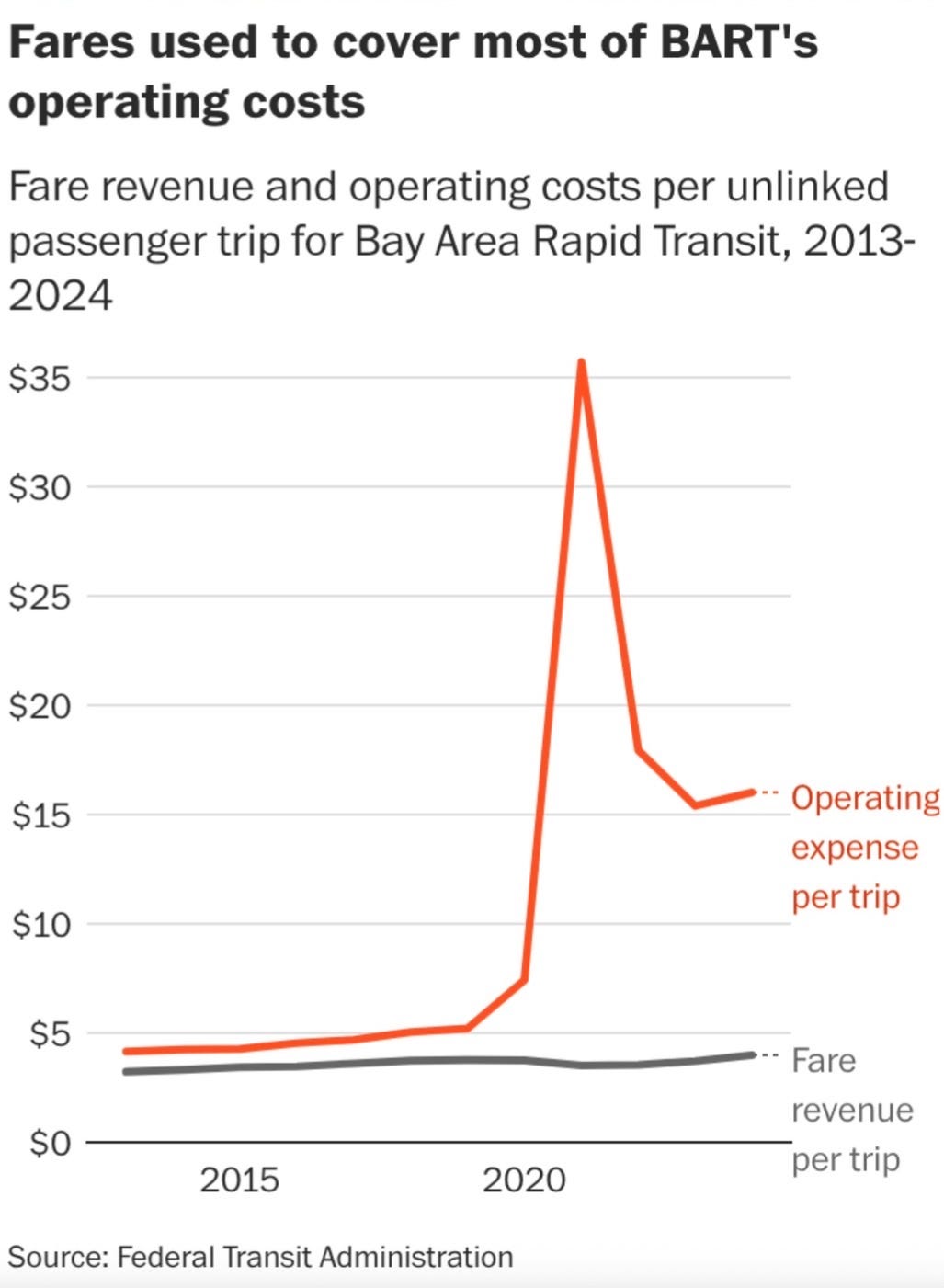
COVID changed that equation. The shutdown emptied trains almost overnight. Afterward came a broader shift in work culture. Millions of Bay Area employees discovered they could work remotely, and many never returned to daily commuting.
Instead of adjusting to this new reality, BART treated the loss of riders as justification for permanent subsidy rather than a signal to rethink how the system operates.
The numbers are striking. In 2024, BART’s operating expenses were about $883 million. Roughly three-quarters of that spending went to labor. At the same time, passengers were taking tens of millions fewer trips than they had in 2019. Yet labor costs increased by more than $150 million. In fact, a reliable source tells me it’s over $170 million, or almost a 30% increase, while at the same time, the same source says that for fiscal year 2024, BART carried 57% fewer riders than before the pandemic. by anyone’s standard that is… dreadful.

The system lost riders while its cost structure grew more expensive.
Now BART warns of major service cuts unless voters approve a new region-wide sales tax. Supporters describe the measure as necessary to save transit. In reality, it would preserve an operating model that BART has shown little willingness to change.
The Sales Tax Fix Is The Wrong Fix
A sales tax is the political class’s preferred method of raising revenue because it spreads the burden widely. Lawmakers do not need to select specific groups to tax. The costs are distributed across everyone buying diapers, school clothes, groceries, and tires.
That is why sales taxes are regressive. The mathematics of the tax structure make the burden heavier on lower-income households.
The Bay Area is already saturated with sales taxes. Oakland now sits at a combined rate of 10.75 percent, among the highest in the nation. Last November, voters in Santa Clara County approved another increase, pushing the countywide rate to roughly 9.875 percent. These numbers reflect only countywide taxes. Many cities impose additional municipal sales taxes that raise the effective rate even higher. At the same time, San Francisco officials are pursuing another full percentage point increase to keep Muni operating.
And Bay Area County budgets aren’t doing so well.
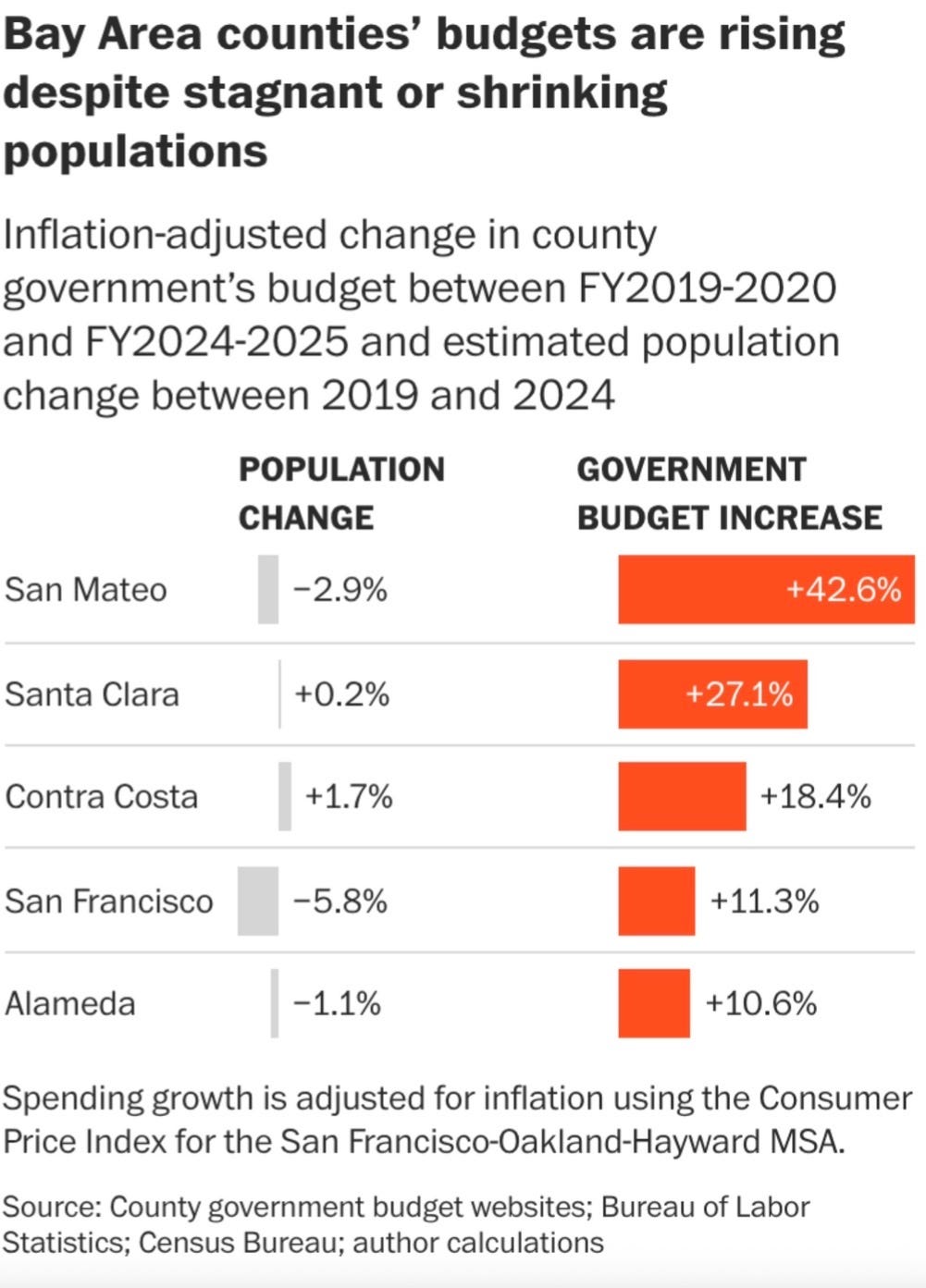
This pattern is not an investment. It is the steady layering of new taxes because public agencies have failed to bring spending under control. Supporters describe the regional BART tax as a temporary bridge. In reality, it would commit taxpayers to 14 years of operating subsidies in a region where commuting patterns have fundamentally changed.
It’s important to note that there are currently no meaningful accountability or oversight measures for big spending at BART, and none are proposed in this massive tax increase proposal, either.
Remote work is not a short-term anomaly. It is a structural change in the regional economy. A transit system designed around pre-2020 commuting assumptions cannot simply wait for those conditions to return.
This Is The End Game Of The Green-Union Bargain
The deeper issue extends beyond BART.
For years, Bay Area politics has rested on a political alliance between climate activists and public employee unions. Environmental advocates push policies designed to reduce car use. Unions seek larger workforces and richer contracts.
The alliance works for a time. Eventually, the incentives collide.
A transit system cannot simultaneously serve as a climate symbol and a protected employment program while remaining financially stable. At some point, the payroll overwhelms the system it was meant to serve.
Consider the logic of a captured ship. Pirates do not limit themselves to the cargo. They strip the vessel of anything valuable. Down to the brass fittings.
That dynamic appears when labor costs lose any connection to ridership and when political incentives punish reform more severely than failure. The issue is not whether workers deserve fair pay. The issue is whether operating costs remain aligned with demand. When demand falls, responsible management revises operations, renegotiates work rules, and modernizes the system.
BART has shown little capacity or willingness to do that.
Part of the explanation lies in federal labor protections attached to transit funding, which make workforce reductions more difficult than in most private enterprises. Another factor is political structure. Unions that negotiate contracts with BART also hold considerable (extreme) influence in BART board elections.
Such arrangements may be legal. However, they do not produce healthy governance. Under those conditions, the result is predictable. The agency seeks new revenue first and postpones structural reform indefinitely.
Doomsday Scenarios Are Not A Plan
Supporters of the tax frequently emphasize catastrophic outcomes. They warn of a death spiral, early train shutdowns, closed stations, and sweeping service reductions.
Some of these scenarios may occur if finances deteriorate further. Fear alone, however, does not constitute a policy strategy. Public confidence grows when institutions present credible reform plans, not when they rely on threats.
If BART believes a tax increase is justified, it should first publish a detailed blueprint for reinvention. That plan should include measurable benchmarks such as workforce targets, overtime reductions, procurement reforms, contract changes, and clear reliability goals.
Voters should see the reform strategy before they are asked to approve a tax increase.
Without structural change, a long-term revenue stream will not solve the underlying problem. It will only postpone the consequences and increase the eventual financial shock.
Reinvention Means Doing Less, With Less
An editorial in the Washington Post last weekend highlighted the central issue (some charts from that editorial are tucked into my column, with appropriate credit). Transit systems themselves are not inherently unworkable. The problem is that American transit agencies operate with unusually high labor costs and limited pressure to modernize.
Automation offers one example. Driverless train systems operate successfully in several global cities. A federally funded study cited by the Post concluded that automation could reduce operating costs by roughly 46%, based on examples from Vancouver and Copenhagen.
Reforms of that magnitude alter long-term cost trajectories.
Automation would require difficult negotiations with unions, navigation of federal labor rules, and significant capital investment. Yet those challenges are smaller than the alternative currently proposed: a multi-county sales tax designed to suck $14 billion more out of taxpayers to preserve a system built for the commuting patterns of 2019.
Meaningful reform also requires a frank conversation about scope. If BART is too large or too costly to operate at its current service levels, the system should be redesigned.
Core corridors should receive priority. Safety and reliability should come first. Administrative overhead should be reduced. Expansion plans should be evaluated against financial reality rather than political aspiration.
A transit system that riders actually use must be able to operate sustainably without recurring emergency appeals for taxpayer assistance.
So, Does It Matter?
This ballot measure should fail. The issue is not whether transit matters. The issue is whether voters retain any leverage over a politically protected public institution. BART is not too large to fail. No public agency is immune to financial reality. Treating transit systems as permanent bailout candidates only ensures that emergency tax increases become routine features of public finance.
A rejection would force difficult choices and overdue reforms. For years, it has been easier for BART and its political allies to seek additional revenue than to rebuild the system for the economic conditions that now exist.
If Bay Area leaders want voter support in the future, they should begin by presenting a credible plan for reinvention. That plan should produce a smaller, more disciplined, modernized transit system capable of sustaining itself without repeated demands for higher taxes.
In the meantime, this tax increase should be rejected by voters. It’s not even a close call.
For our Paid Subscribers
I kept changing my idea about a cartoon for this column, and carefully worked on several before landing on the pirate-themed one above. What were the others? They are below…
