

2A Update: How A Second Amendment Victory In Washington, D.C. Could Help Gun Owners In California
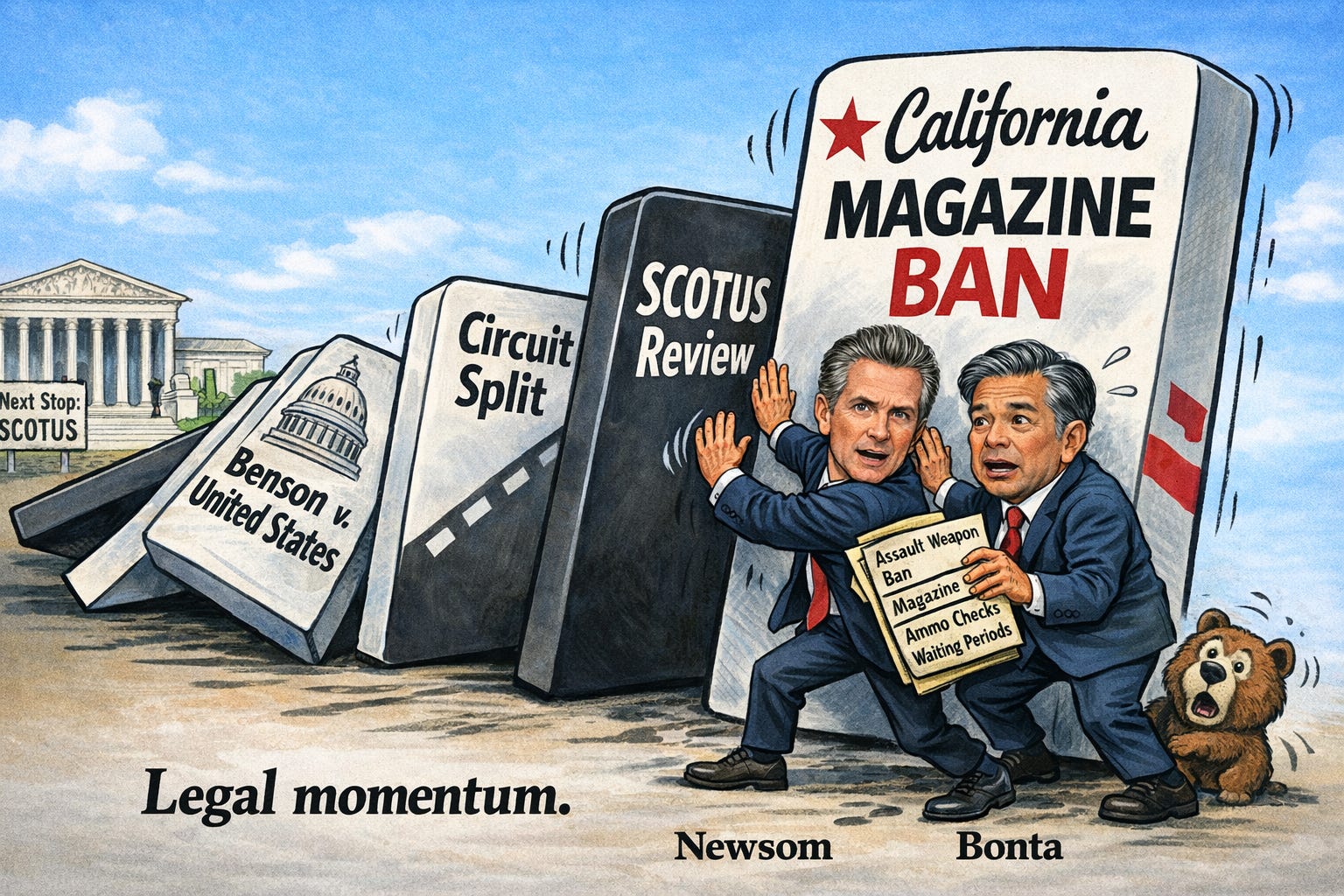
A new ruling from the nation’s capital has created a new legal conflict over magazine bans—and that could put California’s law on a path to the Supreme Court

Our afternoon content is either exclusively for paid subscribers or we have additional exclusive content below the paywall for our hundreds of awesome paid folks. If you like this sort of independent writing, calling balls and strikes, consider upgrading and supporting these efforts! You can listen to this column on our Podcasting Channel - So, Does It Matter? SPOKEN - which is on your favorite podcasting app, or here.
⏱️ 6 min read
A Court Decision In Washington That Could Matter In California
If you live in California, you are used to the idea that Sacramento politicians are constantly looking for new ways to restrict gun ownership. From “assault weapon” bans to waiting periods, ammunition background checks, and magazine limits, California already has some of the most restrictive gun laws in the country. Many of the politicians who run California—from Governor Gavin Newsom on down—would likely go even further if they could. If the Constitution allowed it, many on the political left would support sweeping new limits on private firearm ownership.
But California is still one state. And even here, residents remain protected by the Constitution, the Bill of Rights, and the Second Amendment’s guarantee of the right to keep and bear arms. That is why a recent court decision from Washington, D.C.—thousands of miles away—could have real consequences for gun owners in California. You may ask: how could a ruling from a court in Washington, D.C., affect gun laws in California? The answer lies in how constitutional law works—and how the Supreme Court decides which cases to hear.
A Major Second Amendment Ruling Out Of D.C.
Recently, the District of Columbia Court of Appeals issued a 2–1 ruling in a case called Benson v. United States, striking down Washington, D.C.’s ban on so-called “large-capacity magazines”—those capable of holding more than ten rounds of ammunition. California has an identical restriction.
Writing for the majority, Associate Judge Joshua Deahl concluded that the District’s ban violated the Second Amendment because the magazines it prohibited are widely owned by law-abiding Americans.
“Magazines capable of holding more than 10 rounds of ammunition are ubiquitous in our country… and they come standard with the most popular firearms sold in America today,” Deahl wrote. “Because these magazines are arms in common and ubiquitous use by law-abiding citizens across this country… the District’s outright ban on them violates the Second Amendment.”
Judge Catharine Friend Easterly joined the majority opinion, while Chief Judge Anna Blackburne-Rigsby dissented. The decision overturned the conviction of a man prosecuted under the District’s magazine law and struck down the restriction. That alone would be significant, but the importance of the decision lies in how it collides with a major gun case involving California.
The Case That Directly Affects Californians
The case challenging California’s magazine ban is Duncan v. Bonta. California’s law—enacted by the Legislature and reinforced by Proposition 63 in 2016—makes it illegal for law-abiding citizens to possess magazines holding more than ten rounds.
In 2019, a federal district court judge, Roger Benitez, ruled that the ban violated the Second Amendment. Gun owners briefly experienced what became known as “Freedom Week,” when standard-capacity magazines could be purchased across California. But the Ninth Circuit Court of Appeals later reversed that decision and upheld the state’s ban. That is where the D.C. ruling becomes important.
Two Courts Moving In Opposite Directions
The District of Columbia Court of Appeals is not one of the federal circuit courts that cover multiple states, like the Ninth Circuit. Instead, it serves as the highest court for the District of Columbia—the equivalent of a state supreme court.
However, when that court interprets the Constitution, the only court above it is the Supreme Court. In other words, like the Ninth Circuit, the losing side in the D.C. case has only one place left to go: the Supreme Court.
More importantly, courts are now reaching opposite conclusions about the same constitutional question. The Ninth Circuit says bans on magazines with more than ten rounds are constitutional. The District of Columbia’s court says they are not.
When courts disagree about how the Constitution should be interpreted, that creates a split. Splits are a primary reason the Supreme Court agrees to hear a case. The Court’s job is to ensure the Constitution is applied consistently. When courts issue conflicting rulings on the same constitutional issue, the justices often step in to resolve the dispute. That is why the Benson ruling could have consequences for California. I will add, I am not a lawyer, but the smart lawyer will tell you that DC is not a “Circuit”, therefore this is not technically a “Circuit Split” — but it is a split of sorts, and that can only be helpful.
Why Duncan v. Bonta Could Now Land At The Supreme Court
The case challenging California’s magazine ban—Duncan v. Bonta—is sitting before the Supreme Court, where the justices are deciding whether to grant review.
“The Supreme Court is far more likely to take a case when federal appeals courts are in open disagreement about the same constitutional question. With the D.C. Circuit now ruling that magazine bans are unconstitutional and the Ninth Circuit having upheld California's ban, the split is no longer theoretical — it's undeniable.”
California Rifle And Pistol Association
Legal observers believe the Court could announce the decision soon. The judicial conflict over magazine bans significantly increases the likelihood that the justices will decide the issue once and for all. If the Court rules that bans on commonly owned magazines violate the Second Amendment, California’s law could fall.
That possibility is grounded in Supreme Court Second Amendment decisions. In District of Columbia v. Heller in 2008, the Court confirmed the Constitution protects an individual right to keep and bear arms. Recently, in the 2022 decision New York State Rifle & Pistol Association v. Bruen, the Court ruled modern gun restrictions must be consistent with the historical tradition of firearm regulation.
Under that test, governments must demonstrate that a restriction has a historical analogue dating back to the nation’s founding. Gun-rights advocates argue magazine bans fail that standard. Magazines holding more than 10 rounds are owned by millions of Americans and come standard with the most popular firearms sold for self-defense.
That is the argument being made in Duncan v. Bonta. And the D.C. court’s ruling adds new judicial weight to the claim that magazine bans cannot survive the constitutional test laid out in Bruen.
So, Does It Matter?
For years, California lawmakers have assumed that the courts would tolerate nearly any new firearm restriction they enacted. That assumption has already been shaken by recent Supreme Court decisions. Now, with another court striking down a nearly identical magazine ban, the legal landscape is shifting again.
Whether the justices ultimately take Duncan v. Bonta or not, the constitutional debate over magazine bans is no longer confined to California. The issue is moving toward national resolution.
For Paid Subscribers…
One more cartoon (runner-up!) and more info on this important court decision, plus a link to the ruling.
